
Law Firm Financial System: Definition, Architecture & Why It Matters in 2026
A law firm financial system is a matter-centric legal accounting platform that combines legal billing, trust accounting, compliance, and financial reporting into one unified system. Unlike generic accounting software, it tracks financial activity at the client and matter level while maintaining strict IOLTA compliance and legal trust accounting controls. In 2026, law firms increasingly rely on modern legal finance systems for real-time matter profitability visibility, automated compliance monitoring, WIP reporting, and scalable legal financial operations.
Modern law firms require far more than basic accounting software. They need a modern law firm financial system capable of handling complex legal billing structures, strict legal trust accounting regulations, matter-level profitability tracking, and audit-ready compliance workflows—all within a single unified platform.
Written by Knowledge Team, posted on May 11, 2026

As firms grow, disconnected tools create operational blind spots, compliance risks, and revenue leakage. This is why many legal organizations are moving toward integrated legal finance systems and legal ERP-style platforms purpose-built for the legal industry.
What Is a Law Firm Financial System?
A law firm financial system is a matter-centric accounting and financial management platform designed specifically for legal practices. Unlike generic accounting systems that organize transactions primarily around departments or accounts, legal financial systems organize all financial activity around clients and matters.
These systems manage core legal financial operations including:
- Legal billing and invoicing
- Legal accounting
- Trust accounting (IOLTA)
- Matter-level expense tracking
- Revenue recognition
- Compliance and audit controls
- Financial reporting and profitability analysis
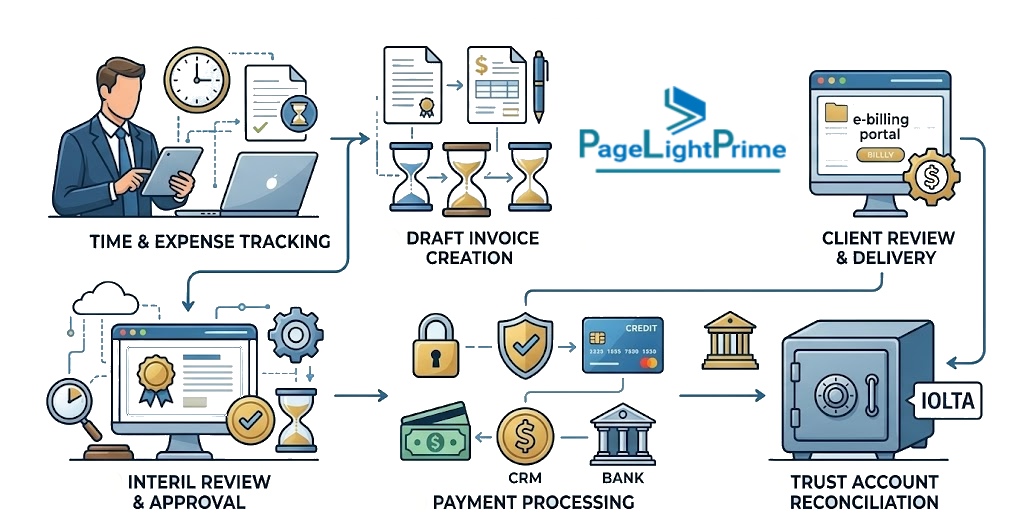
The defining characteristic of a law firm finance platform is that financial operations are directly tied to legal matters, enabling firms to understand matter profitability, risk exposure, billing efficiency, and operational performance at a granular level.
This is why firms are increasingly adopting purpose-built legal accounting software instead of adapting traditional accounting systems that were never designed for legal practice accounting workflows.
Why Law Firms Need Specialized Financial Systems
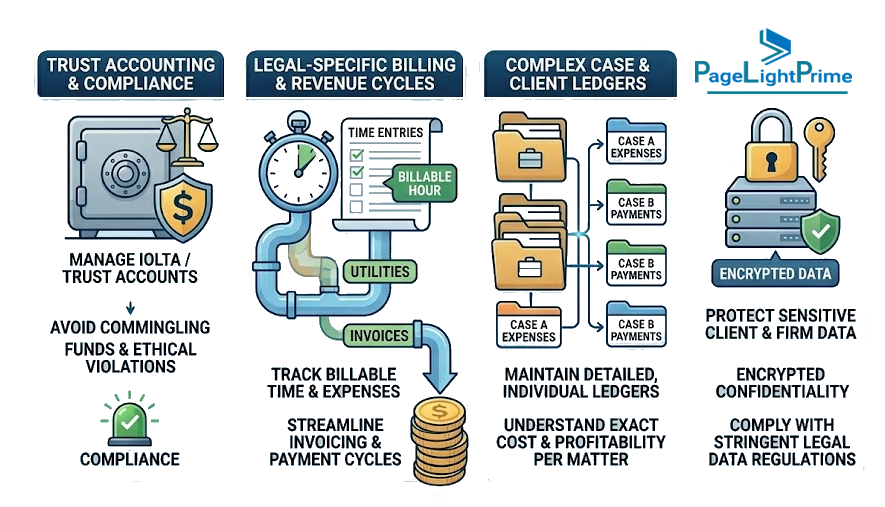
Law firms increasingly require dedicated legal finance systems because traditional accounting tools fail to address the operational and regulatory complexity of legal practice. Without purpose-built platforms, firms face significant risks and inefficiencies that directly impact profitability and compliance.
Key challenges include:
- Compliance risk related to IOLTA rules and legal trust accounting requirements
- Records management: retention and lifecycle control of legal documents
- Revenue leakage caused by unbilled time, missed expenses, and write-downs
- Billing inefficiency due to manual workflows and fragmented systems
- Lack of matter visibility across clients, cases, and practice groups
- Fragmented tools that separate billing, accounting, and compliance into disconnected systems
These issues limit financial transparency and reduce the ability of firms to manage legal financial operations effectively at scale.
What Is a Law Firm Financial System?
A law firm financial system is a specialized financial platform designed specifically for legal practices where accounting, billing, trust management, and reporting are all handled at the matter level.
Traditional accounting systems focus primarily on company-wide bookkeeping. Legal finance systems, by contrast, must simultaneously support operational accounting, client fund protection, regulatory compliance, and detailed matter profitability tracking.
The Core Concept
At the center of every legal financial platform is the concept of matter-based accounting.
Every transaction—including time entries, invoices, trust movements, expenses, write-offs, collections, and revenue allocations—is associated with a client matter.
This structure enables firms to answer critical operational questions such as:
- Which matters are most profitable?
- Which practice areas generate the highest realization rates?
- Which clients consistently delay payment?
- How much unbilled work exists across active matters?
- Which matters consume the highest operational cost?
Unlike generic accounting tools, law firm financial systems must simultaneously manage:
- Client trust funds (IOLTA accounts)
- Firm operating accounts
- Matter-level billing workflows
- Compliance obligations
- Auditability requirements
- Multi-entity legal accounting structures
Because of these specialized requirements, generic accounting tools often become operational bottlenecks as firms scale.
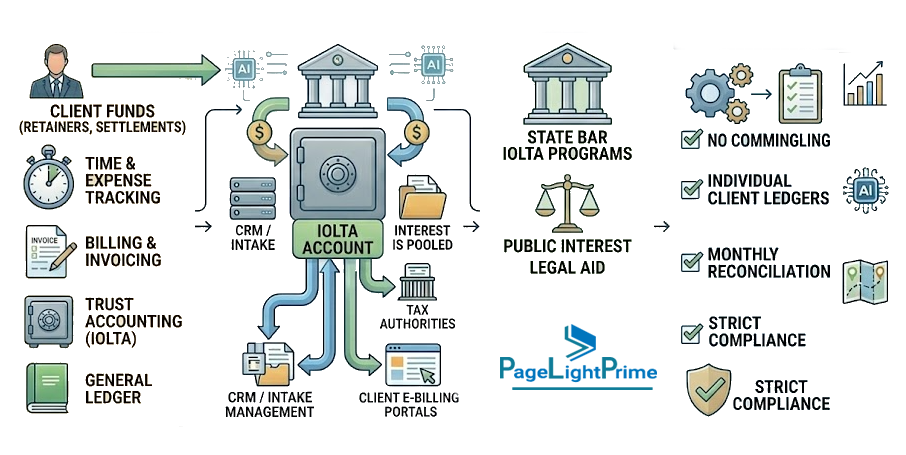
Key Characteristics of a Legal Financial System
1) Matter-Centric Accounting
Matter-centric accounting is the foundation of legal financial management.
Every financial transaction is linked directly to a client matter:
- Revenue tracked per case
- Expenses allocated per matter
- Time entries associated with legal work
- Trust balances maintained by matter
- Profitability analyzed at the matter level
This approach—commonly referred to as matter-based accounting—provides significantly greater operational visibility than traditional departmental accounting models.
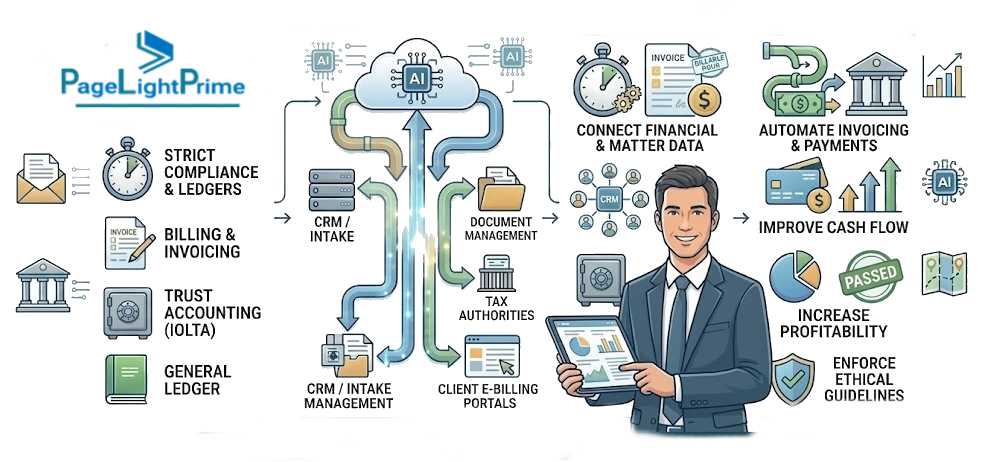
Instead of relying solely on high-level firm-wide financial reporting, firms can evaluate the actual financial performance of individual matters, attorneys, clients, and practice groups.
This level of visibility becomes essential for:
- Resource allocation
- Pricing strategy
- Staffing decisions
- Alternative fee arrangement analysis
- Revenue forecasting
- Partner compensation modeling

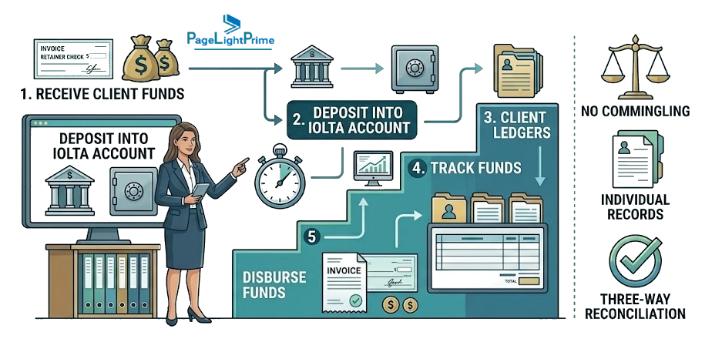
2) Trust Accounting
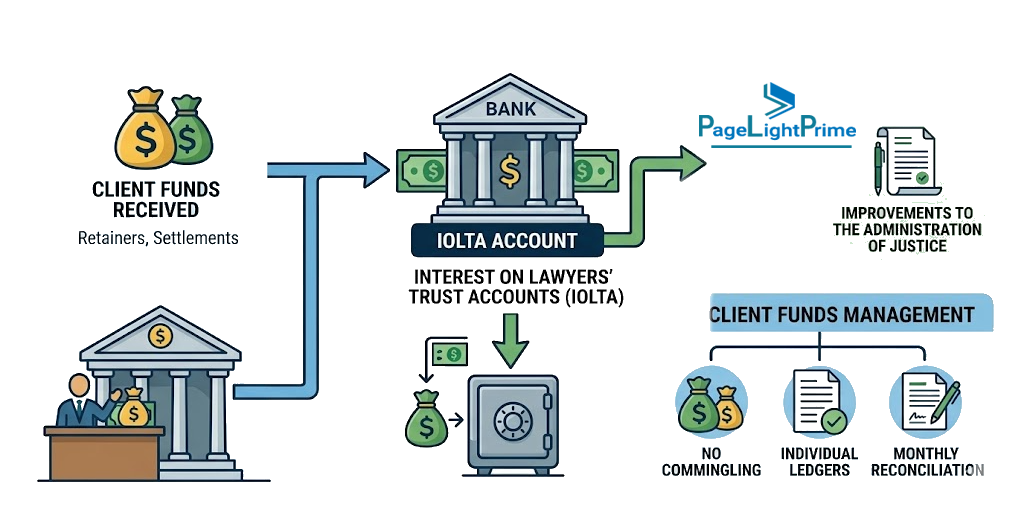
Trust accounting is one of the most critical capabilities within a legal financial system.
Law firms frequently hold client funds in trust accounts, often regulated under IOLTA (Interest on Lawyers Trust Accounts) rules. Mishandling these funds can lead to severe compliance violations, disciplinary action, or reputational damage.
A compliant legal trust accounting system ensures:
- Strict segregation of client funds
- No commingling with operating accounts
- Matter-level trust ledgers
- Complete audit trails
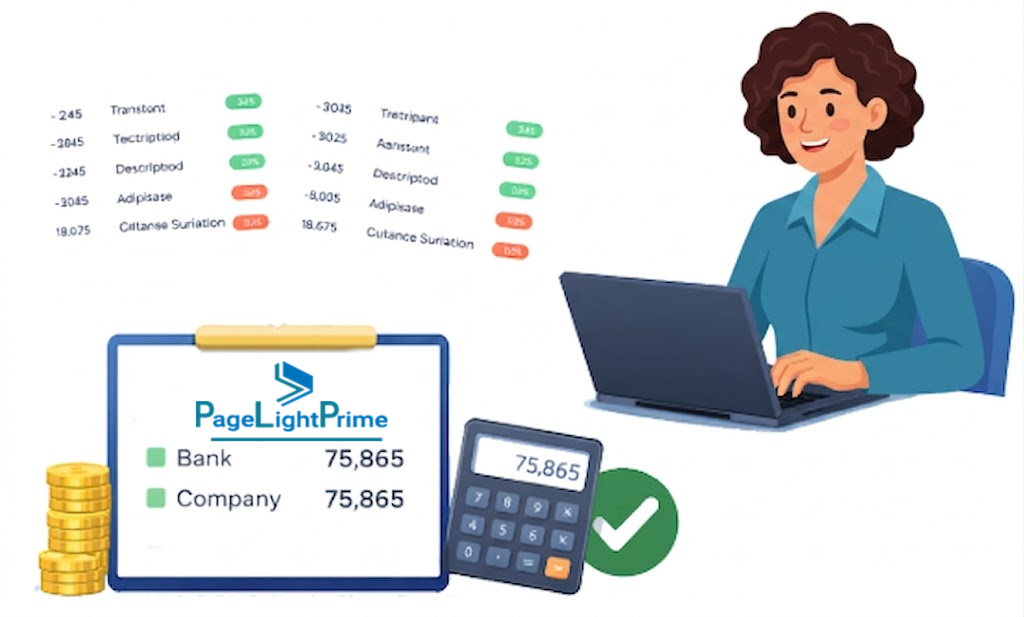
- Three-way trust reconciliation
- Controlled disbursement workflows
- Accurate trust balance reporting
Strong IOLTA compliance software capabilities are essential for preventing violations, maintaining transparency, and supporting trust accounting software for law firms.
Modern legal financial systems increasingly automate trust reconciliation processes and continuously monitor transactions for compliance anomalies.
3) Billing & Revenue Management
Legal billing is significantly more complex than standard invoicing.
Law firms frequently operate using multiple billing arrangements simultaneously, including:
- Hourly billing
- Flat fee arrangements
- Contingency fee billing
- Hybrid fee structures
- Subscription-based legal services
- LEDES billing formats
- E-billing compliance requirements
This is where advanced law firm billing software becomes central to legal financial operations.
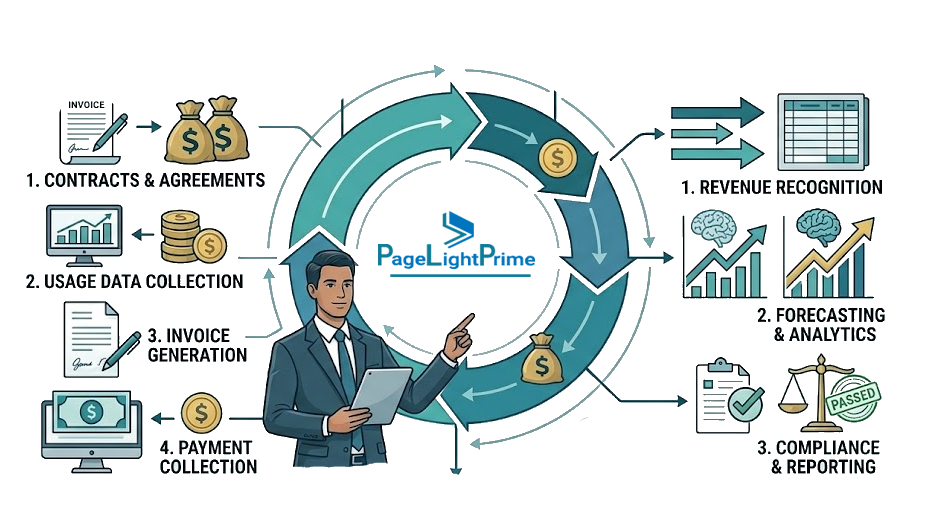
Modern billing engines support:
- Time tracking and time capture → into
- Rate cards and attorney rates
- Automated invoice generation
- Pre-bill review workflows
- Electronic billing standards
- Write-down and write-off management
- Multi-currency billing
- Split billing arrangements
Billing systems also increasingly incorporate AI-assisted narrative generation to reduce administrative overhead and improve invoice clarity.

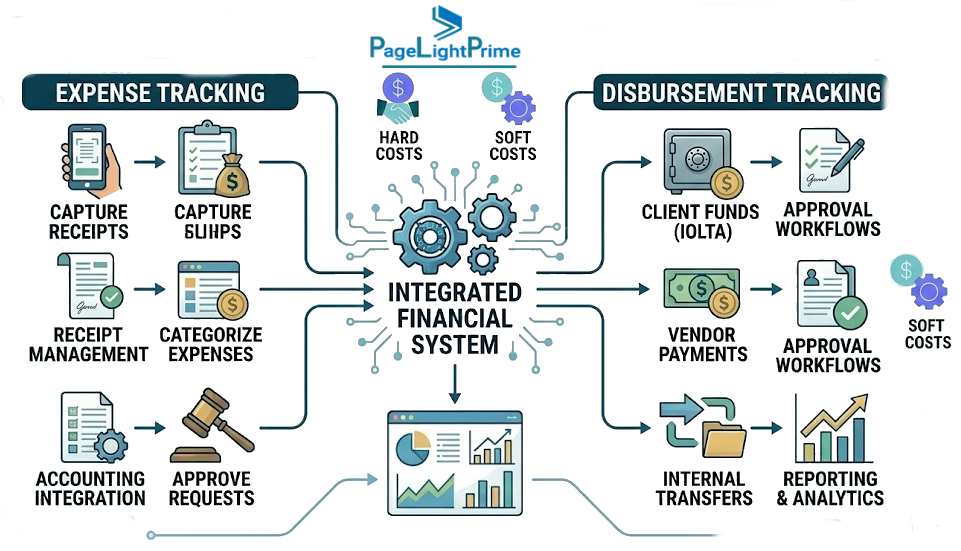
4) Expense & Disbursement Tracking
Law firms must carefully track both billable and non-billable expenses associated with matters.
Legal finance platforms generally separate expenses into two categories:
Hard Costs
Direct client expenses such as:
- Court filing fees
- Expert witness costs
- Deposition expenses
- Travel expenses
- Third-party vendor charges
Soft Costs
Internal operational expenses such as:
- Printing and copies
- Postage
- Administrative services
- Internal research expenses
- Technology usage allocations
Accurate expense tracking is essential for:
- Client cost recovery
- Matter profitability analysis
- Budget management
- Revenue optimization
- Financial forecasting
Modern systems automate expense allocation directly to matters, reducing manual accounting effort and minimizing billing leakage.
5) Compliance & Auditability
Compliance requirements in legal finance are significantly stricter than in many other industries.
A robust legal billing and accounting system must support:
- Jurisdiction-specific trust accounting rules
- Immutable audit logs
- Segregation of duties
- Approval workflows
- Financial traceability
- Historical transaction retention
- Reversal-based corrections
- Automated compliance alerts

Every financial action should be fully traceable.
- Bar association audits
- Internal financial reviews
- Client disputes
- Regulatory investigations
- External accounting audits
Modern systems increasingly implement automated compliance monitoring to identify suspicious activity, trust shortfalls, or reconciliation discrepancies in real time.

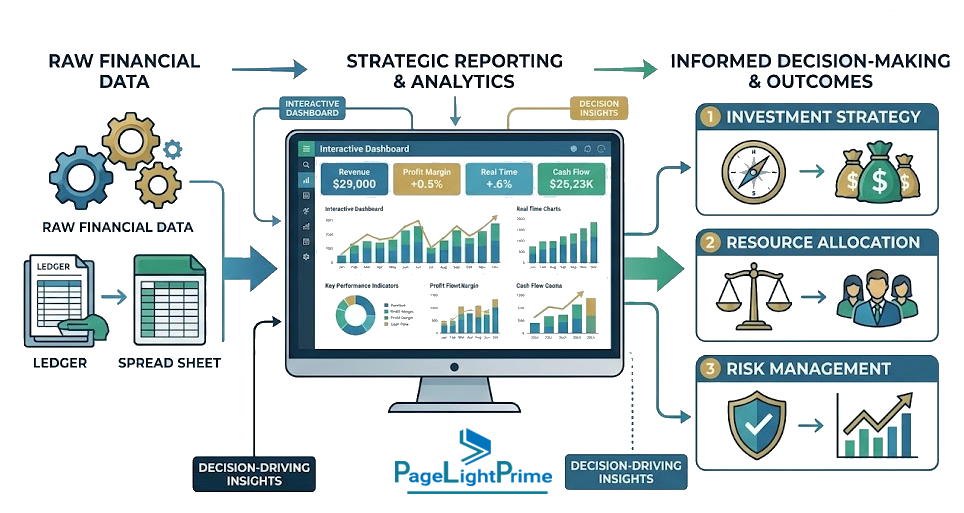
6) Financial Reporting That Drives Decisions
Advanced legal financial systems provide operational intelligence in addition to standard accounting reports.
Firms rely heavily on financial and operational metrics such as:
- Matter profitability
- WIP (Work in Progress) and WIP reporting
- AR (Accounts Receivable)
- Utilization rates
- Realization rates
- Collection rates
- Billing velocity
- Practice group performance
- Revenue forecasting

These metrics support strategic decision-making across:
- Partner management
- Practice development
- Pricing strategy
- Staffing optimization
- Client portfolio management
- Cash flow planning
Real-time dashboards increasingly allow firms to monitor financial performance continuously rather than relying solely on monthly reporting cycles.
Law Firm Financial System vs Generic Accounting Software
Many law firms initially adopt general accounting platforms such as QuickBooks or Xero. While these systems can support basic bookkeeping, they are not designed to handle the operational, regulatory, and billing complexity of legal practices.
As firms grow, these limitations often create significant operational inefficiencies.
The table below highlights the differences between generic accounting software and a purpose-built law firm financial system.
| Feature | Generic Accounting Software | Law Firm Financial System |
|---|---|---|
| Primary Financial Structure | Account / Department | Client / Matter |
| Trust Accounting | Manual workarounds required | Native IOLTA-ready workflows |
| Billing Models | Standard invoices | Hourly, flat fee, contingency, LEDES |
| Matter Profitability | Limited visibility | Real-time matter profitability | Cost Recovery | Difficult to allocate | Automated matter-based allocation | Compliance Controls | Minimal legal-specific controls | Built-in compliance enforcement | Audit Trails | Basic transaction history | Immutable audit-ready logs | WIP Tracking | Limited support | Native WIP management | AR Management | General AR only | Matter-level collections tracking | Workflow Integration | Limited legal integrations | Legal workflow integrations | Reporting | Firm-level reporting | Matter-level operational analytics |
Legal Finance System Architecture
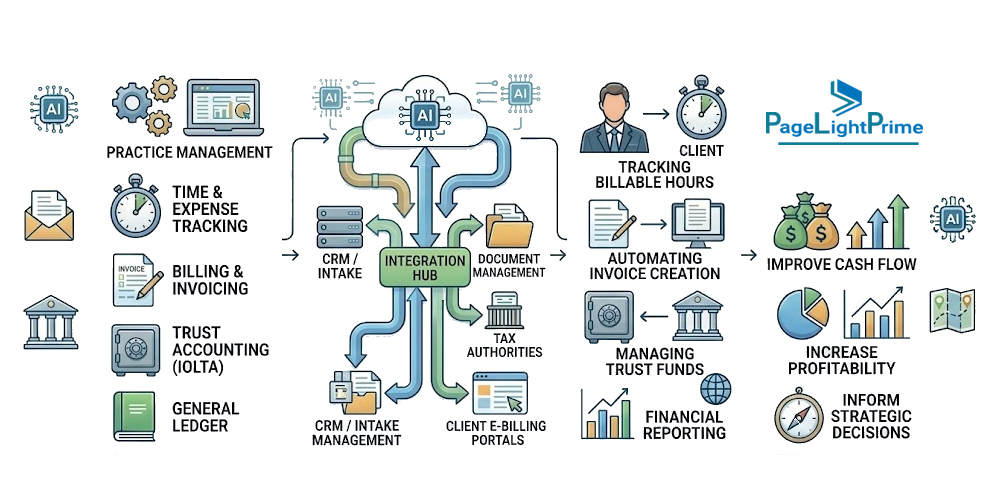
A modern legal finance system is typically designed as a layered architecture that combines accounting, compliance, workflow management, billing operations, and integrations into a unified law firm finance platform.
The architecture must support:
- High transaction integrity
- Regulatory compliance
- Real-time reporting
- Secure financial operations
- Matter-centric workflows
- Scalable integrations
- Multi-office legal operations
Modern systems are increasingly cloud-native and designed for distributed legal teams.
A) High-Level Architecture Layers
1) Presentation Layer
The presentation layer provides interfaces for attorneys, finance teams, administrators, and clients.
Typical components include:
- Web applications
- Billing dashboards
- Financial reporting portals
- Mobile interfaces
- Client payment portals
- Administrative consoles
- Executive reporting dashboards
This layer focuses on usability, accessibility, and secure role-based access.
Modern interfaces increasingly provide real-time financial insights and workflow automation.

2) Application Layer (Core Business Logic)
The application layer contains the operational intelligence of the system.
This is where legal workflows, accounting rules, compliance controls, and billing logic are enforced.
a) Matter Management Service
The matter management service maintains:
- Matter lifecycle tracking
- Client-matter relationships
- Practice area categorization
- Matter metadata
- Responsible attorney assignments
- Financial ownership structures
This service acts as the operational foundation for all financial activity.

b) Billing Engine
The billing engine handles:
- Time entry processing
- Rate management
- Invoice generation
- Pre-bill workflows
- LEDES formatting
- Split billing
- Automated billing rules
- Collections workflows
Advanced billing systems increasingly support AI-assisted invoice narratives and automated billing validation.

c) Trust Accounting Engine
The trust accounting engine is one of the most sensitive and business-critical components in the architecture.
Its responsibilities include:
- Matter-level trust ledgers
- Trust deposits and withdrawals
- Trust reconciliation
- IOLTA compliance controls
- Transaction validation
- Bank synchronization
- Trust balance monitoring
This component is central to maintaining financial integrity, legal trust accounting standards, and regulatory compliance.

d) General Ledger (GL)
The GL subsystem manages:
- Chart of accounts
- Journal entries
- Financial statements
- Revenue recognition
- Expense allocation
- Cash management
- Multi-entity accounting
Even though the platform is matter-centric, it must still maintain traditional double-entry accounting standards.
e) Expense Management Module
The expense management module handles:
- Disbursement tracking
- Vendor integrations
- Reimbursable expenses
- Internal cost allocation
- Cost recovery workflows
- Receipt management
This module helps firms improve billing accuracy while reducing unrecovered expenses.
f) Compliance & Audit Module
The compliance layer enforces:
- Financial approval rules
- Audit logging
- Segregation of duties
- Jurisdiction-specific controls
- Reconciliation monitoring
- Historical traceability
Modern systems increasingly implement automated compliance alerts and anomaly detection.

3) Data Layer
The data layer stores the core financial and operational entities used throughout the platform.
Core Entities Typically Include:
- Client
- Matter
- Attorney
- Trust Account
- Invoice
- Payment
- Ledger Entry
- Expense
- Time Entry
- Vendor
- Financial Period
This structure enables scalable matter-centric financial tracking across the organization.
Modern systems increasingly use hybrid transactional and analytical data architectures to support both operational processing and real-time analytics.

4) Integration Layer
Modern legal finance platforms must integrate with a wide range of operational systems.
Common integrations include:
- Document management systems
- Practice management platforms
- Payment gateways
- Banking systems and bank feeds
- Microsoft 365 for law firms
- ERP systems
- Payroll systems
- E-filing platforms
- CRM systems
- Identity management systems
Strong integration architecture reduces duplicate data entry and improves operational consistency across the firm.
API-first architectures are increasingly becoming standard in legal technology platforms.

5) Infrastructure Layer
The infrastructure layer provides the operational environment supporting the platform.
Modern systems commonly rely on:
- AWS
- Microsoft Azure
- Google Cloud Platform (GCP)
Infrastructure capabilities typically include:
- Secure cloud hosting
- Multi-tenant or single-tenant deployment models
- Encryption at rest
- Encryption in transit
- Role-based access control
- Disaster recovery systems
- High availability architecture
- Geographic redundancy
- Continuous monitoring
Security and compliance are especially critical because legal financial systems manage highly sensitive client and financial information.

B) Reference Architecture (Simplified Flow)
[User / Lawyer]
↓
[Web App / User Interface]
↓
[Application Services]
├── Matter Service
├── Billing Engine
├── Trust Accounting Engine
├── General Ledger Engine
├── Compliance Module
↓
[Database Layer]
↓
[Integration Services]
This layered approach allows firms to scale operationally while maintaining financial integrity and compliance.

C) Critical Design Principles
1) Matter Is the Primary Financial Dimension
Everything within the system flows through the relationship:
Client → Matter → Financial Activity
This design ensures that all financial operations can be analyzed and reported at the matter level.
Matter-centric architecture is what differentiates legal financial systems from conventional accounting software.
2) Double-Entry Accounting + Matter Dimension
Every transaction must support:
- Debit and credit accounting standards
- Matter-level allocation
- Financial traceability
- Audit consistency
This enables firms to maintain GAAP-compliant accounting while also supporting operational matter analytics.

3) Trust vs Operating Fund Separation
Client trust funds and firm operating funds must remain strictly separated.
This separation should be enforced at:
- The accounting level
- The workflow level
- The banking integration level
- The compliance monitoring level
This design principle is essential for preventing commingling violations.

4) Event-Driven Financial Updates
Modern systems increasingly use event-driven workflows.
Examples include:
- Time entry → WIP update
- Invoice generation → AR creation
- Payment receipt → Matter allocation
- Trust withdrawal → Compliance validation
This approach enables real-time financial visibility and operational automation.
5) Immutable Audit Trails
Modern legal billing and accounting systems should maintain immutable transaction histories.
Best practices include:
- No hard deletions
- Reversal-based corrections
- Full user activity logging
- Historical reconciliation tracking
- Timestamped financial events
This level of traceability significantly improves audit readiness and compliance integrity.

D) Modern Enhancements (2025–2026 Trends)
The legal finance technology landscape is evolving rapidly.
Modern law firm financial systems increasingly incorporate advanced capabilities such as:
- AI-assisted billing narratives
- Predictive cash flow forecasting
- Real-time matter profitability dashboards
- Automated compliance monitoring
- Embedded payment processing
- Workflow automation
- AI-driven anomaly detection
- Integrated document and financial workflows
- Cross-system operational analytics
- Intelligent collections prioritization
Firms are increasingly consolidating disconnected systems into unified legal operations platforms.

Platforms such as PageLightPrime represent the next generation of legal financial systems by combining:
- Document management
- Matter management
- Billing operations
- Trust accounting
- Compliance monitoring
- Financial reporting
- Workflow automation
within a single unified environment.

This transition matters because fragmented systems create:
- Compliance risks
- Data inconsistencies
- Billing inefficiencies
- Operational duplication
- Limited financial visibility
- Increased administrative overhead
Modern firms increasingly require unified platforms capable of delivering real-time operational and financial insight at the matter level.
E) One-Line Architecture Summary
A legal finance system architecture is a layered, matter-centric platform design that integrates billing, trust accounting, compliance, operational workflows, and general ledger functions into a unified financial ecosystem for legal practices.

“
Final Thought
Law firms are steadily moving toward unified financial platforms that combine billing, accounting, compliance, and operational workflows into a single integrated system.
As legal operations become more data-driven and compliance requirements continue to increase, fragmented accounting environments become increasingly difficult to manage.
Adopting a modern legal financial platform—whether positioned as:
- legal accounting software,
- law firm billing software
- legal finance software,
- or a complete law firm financial management platform,

enables firms to achieve:
- Stronger trust accounting compliance
- Real-time matter-level visibility
- Improved profitability analysis
- More efficient billing operations
- Better cash flow management
- Reduced administrative overhead
- Improved audit readiness
- Scalable financial operations
Most importantly, modern legal finance systems transform financial management from a purely administrative function into a strategic operational capability.
If a firm’s current systems cannot provide real-time insight into profitability, billing performance, trust balances, and matter-level financial activity, it may be time to rethink the firm’s financial foundation.
In 2026 and beyond, matter-centric financial visibility is rapidly becoming a competitive requirement rather than a technological advantage.

“
FAQ: Frequently Asked Questions
How is a legal accounting software different from generic accounting tools?
Legal accounting software is designed for matter-based accounting, IOLTA compliance, and legal billing workflows, whereas generic tools focus on general business bookkeeping without support for legal trust accounting or matter-level financial tracking.
What is matter-based accounting?
Matter-based accounting is a financial structure where all transactions—billing, expenses, payments, and trust activity—are linked directly to a client matter, enabling accurate matter profitability analysis and better legal financial operations.
Why is trust accounting important for law firms?
Trust accounting ensures client funds are properly segregated in compliance with IOLTA rules, preventing commingling and ensuring audit-ready compliance trails for regulatory oversight.
What is LEDES billing?
LEDES billing is a standardized electronic billing format used by law firms and corporate clients to streamline invoice submission, review, and processing in legal billing systems.
What are WIP and matter profitability?
WIP (Work in Progress) represents unbilled legal work, while matter profitability measures revenue versus cost at the matter level, helping firms evaluate financial performance accurately.
Why do law firms need specialized financial systems?
Law firms need specialized systems to reduce compliance risk, eliminate revenue leakage, improve billing efficiency, and gain real-time visibility into matter-level financial performance.