
Mastering Insurance Defense Billing: End-to-End Workflow and Best Practices
An effective insurance defense billing workflow ties together matter setup, disciplined time capture with UTBMS coding, LEDES-compliant invoicing, and a structured pre-bill review. This ensures carrier guidelines are met, rejections are minimized, and firms maximize realization while maintaining compliance.
Insurance defense billing follows strict carrier billing guidelines, uses UTBMS billing codes, and requires LEDES-compliant invoices submitted through legal e-billing platforms.
Written by Knowledge Team, posted on March 26, 2026
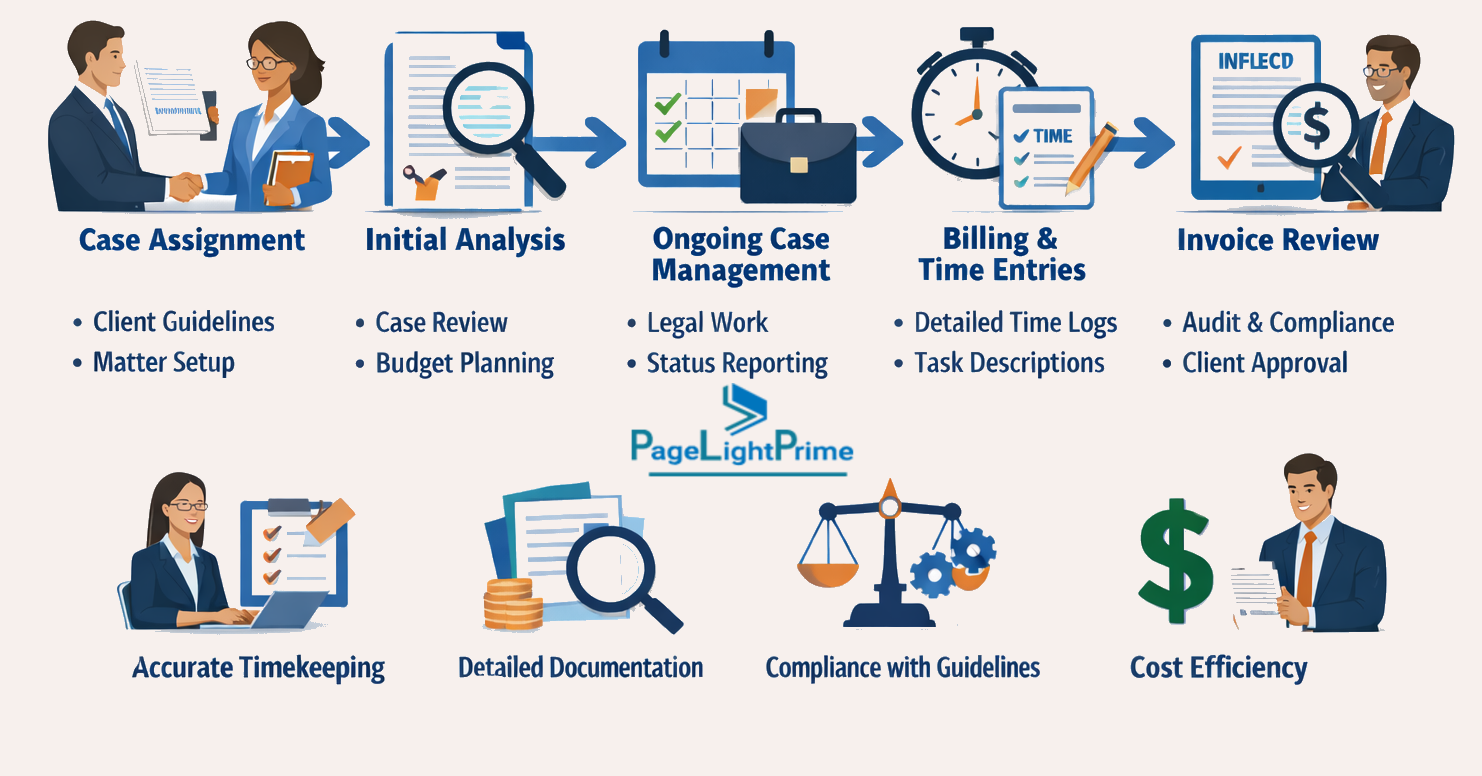
At its core, an effective insurance defense billing workflow is a structured, repeatable process that captures time accurately, enforces carrier guidelines, and pushes clean LEDES/e-bills out quickly with pre-submission quality assurance.
Insurance defense billing best practices require strict compliance with carrier billing guidelines, correct UTBMS billing codes, proper LEDES billing format, and disciplined pre-bill review before invoices are submitted through legal e-billing systems.
What Is Insurance Defense Billing?
Insurance defense billing is the structured process used by law firms to record time, apply UTBMS task and activity codes, generate LEDES-compliant invoices, and submit bills to insurance carriers through e-billing systems while complying with carrier billing guidelines.
This process typically includes matter setup, time entry with UTBMS codes, automated billing rule validation, pre-bill review, LEDES export, electronic submission, and post-submission adjustments to ensure compliance with insurance carrier billing guidelines and maximize realization.
Insurance defense billing typically uses UTBMS task codes, LEDES billing formats, and legal e-billing platforms such as TyMetrix, CounselLink, and Legal Tracker to submit invoices to insurance carriers in compliance with billing guidelines.
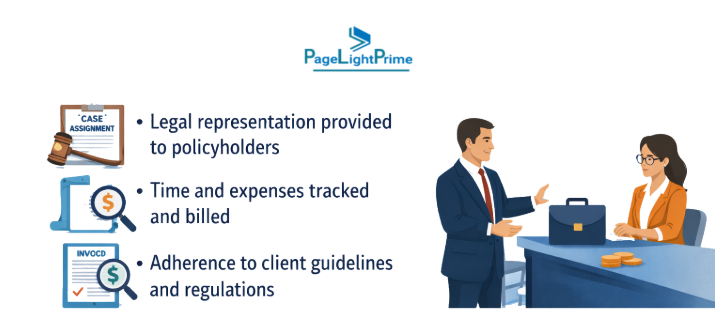
Key elements of insurance defense billing:
- UTBMS task, activity, and expense codes
- LEDES billing format
- Carrier billing guidelines
- Time entry compliance
- Pre-bill review
- E-billing submission
- Reduction appeals
- Billing analytics
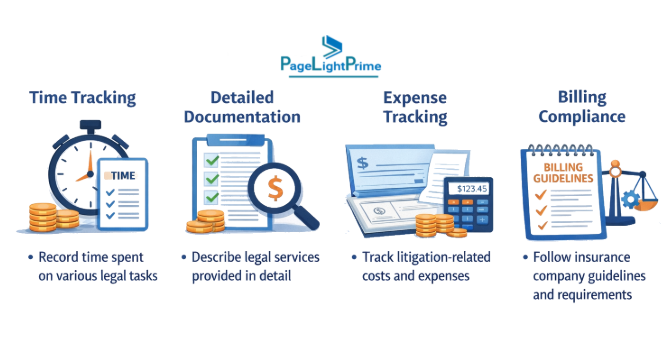
Insurance Defense Billing Workflow Overview
An effective insurance defense billing workflow includes:
- Carrier & matter setup
- Budget & guideline configuration
- Ongoing time & expense capture
- Automated compliance checks
- Pre-bill generation
- Attorney review
- LEDES export & e-billing submission
- Appeals & adjustments
- Collections & payment tracking
- Analytics & continuous improvement
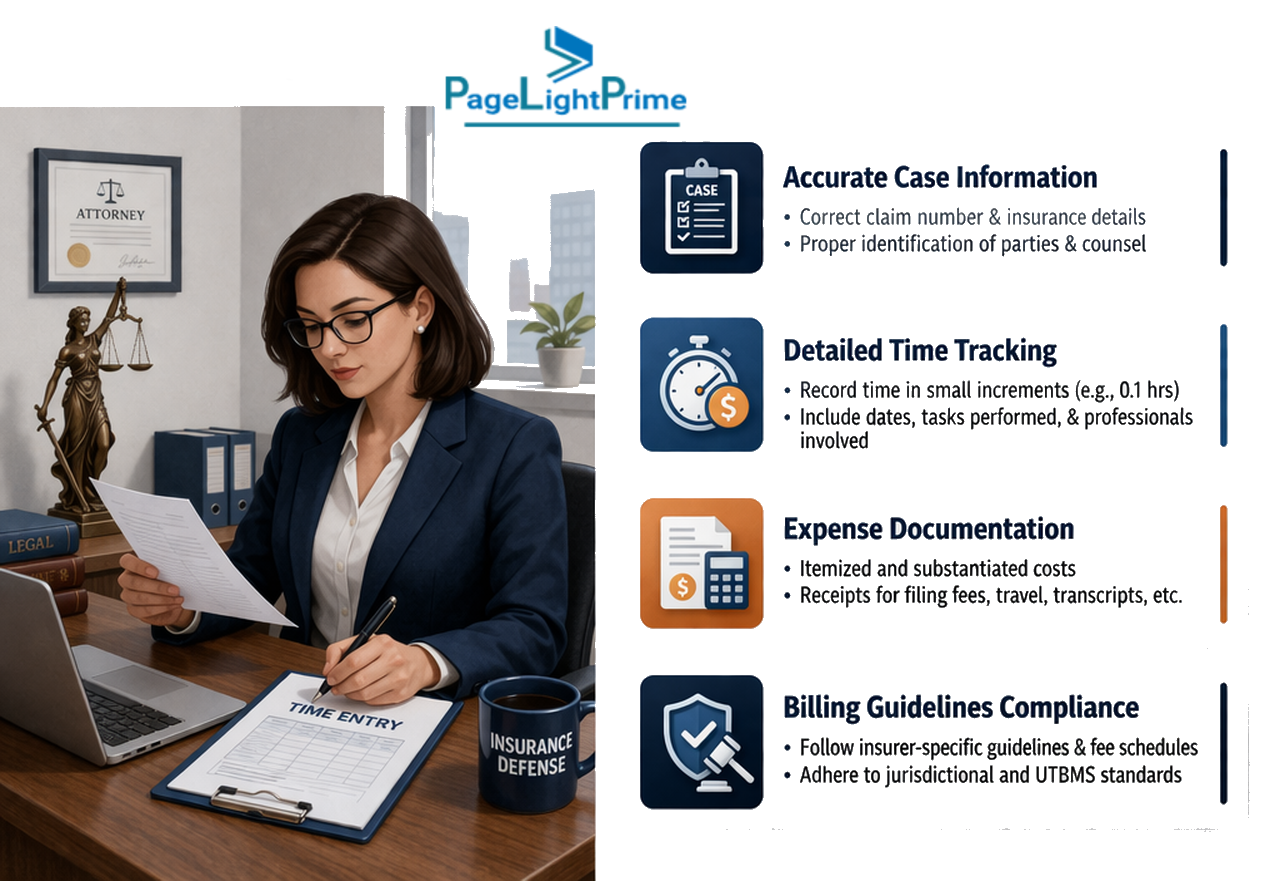
An effective insurance defense billing workflow includes:
Each step ensures compliance with carrier billing guidelines and reduces invoice rejections. This insurance defense billing workflow aligns with standard insurance carrier billing guidelines, UTBMS billing code requirements, and LEDES e-billing submission rules used by most insurance companies.
Legal accounting software, including PageLightPrime, can help firms manage insurance defense billing workflows by supporting UTBMS coding, LEDES export, multi-payor billing, and multiple rate structures. In complex matters, where multiple carriers and differing rate agreements are involved, these tools help ensure invoices are accurate, compliant, and efficiently submitted.

End-to-End Workflow
1. Carrier & Matter Setup
Start with a robust foundation:
- Carrier profile: Define approved UTBMS task, activity, and expense codes; timekeeper rates; maximum units per task; and narrative rules (e.g., banned words, minimum detail).
- Billing system configuration: Enforce these rules as validation logic for all matters associated with that carrier.
- Guideline capture: Capture carrier billing guidelines, rate agreements, budgets, UTBMS requirements, and e-billing portal specifications at matter opening.
- Rule enforcement: Configure system controls such as approved timekeepers, rate tables, block billing bans, travel limitations, and no-charge administrative tasks.

2. Matter Intake & Budget
At matter opening:
- Run automated validation rules for:
- Use exception reports so billing staff and attorneys can correct or adjust entries before they appear on pre-bills.
This step prevents cascading rejections and reduces manual rework later in the billing cycle.

3. Ongoing Time & Expense Capture
Disciplined, contemporaneous time entry is essential:
- Record tasks with UTBMS task + activity codes and standard narratives tailored to insurer expectations.
- Require daily time and expense capture with contemporaneous entries.
- Avoid block billing, vague descriptions, and large aggregated time entries.
- Track soft costs (copies, postage) and hard costs (experts, court reporters) using appropriate UTBMS expense codes and carrier-specific rules.
- Capture expenses with pre-approval flags for experts, travel, and major disbursements when guidelines require prior authorization.

Best Practices for Time Tracking
- Enter time in real time to avoid losing 10–25% of billable hours.
- Use timers and quick-switch apps to reduce leakage and maintain accurate descriptions.
- Tie calendar events to time entries to validate accuracy.
- Maintain a firm-level glossary of standard narratives that are outcome-oriented and compliant.
- Conduct a weekly micro-review of entries for clarity, correct codes, and compliance before pre-bills are generated.

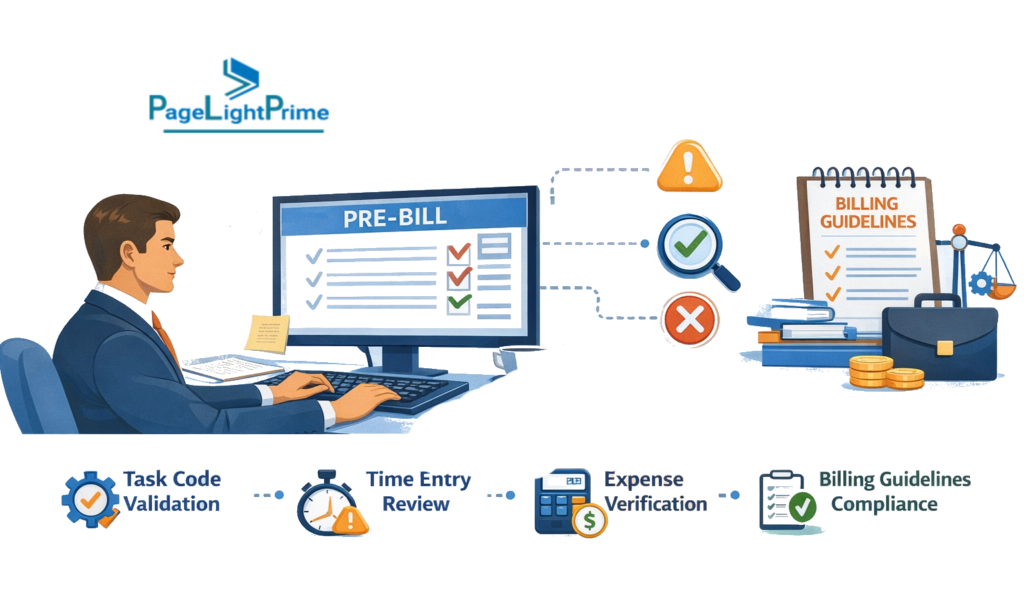
4. Automated Compliance Checks (Pre-Bill Stage)
Before pre-bills are generated:
- Run automated validation rules for:
- Missing or invalid codes
- Non-approved timekeepers
- Rate mismatches
- Prohibited or restricted tasks
- Billing over caps or unit limits
- Out-of-sequence or illogical activity entries
- Use exception reports so billing staff and attorneys can correct or adjust entries before they appear on pre-bills.
This step prevents cascading rejections and reduces manual rework later in the billing cycle.
5. Pre-Bill Generation
Generate draft bills (by matter or carrier batch):
- Produce human-readable pre-bills (PDF or system view).
- Ensure all automated compliance checks are passed before attorney review.
- Group bills logically (by matter, carrier, or billing cycle) based on carrier requirements.
6. Attorney Review & Adjustment
- Responsible attorneys review pre-bills for:
- Narrative quality and demonstration of value
- Compliance with carrier guidelines and budgets
Additional expectations:
- Ensure narratives clearly show value, necessity, and litigation alignment
- Justify unusual or high-cost work proactively
- Apply write-downs or write-offs where needed
- Confirm alignment with litigation strategy and phase expectations
Pre-bills should be revalidated after edits to ensure continued compliance.

7. LEDES Export & E-Billing
Export approved invoices in carrier-required formats:
- Convert pre-bills into LEDES 1998B or other required formats
- Include all required elements: UTBMS codes, timekeeper classifications, rates, taxes, adjustments, and matter identifiers
- Upload to e-billing platforms (e.g., TyMetrix, CounselLink) or submit via integrations, Insurance defense billing platforms, such as PageLightPrime, provide features like built-in LEDES generation, carrier guideline validation, and support for multi-payor and multi-rate billing—helping firms submit invoices that meet carrier requirements with fewer errors.
- Confirm technical acceptance and monitor for immediate auto-reductions
LEDES Considerations
- Standardized, pipe-delimited structure ensures consistency
- Enables automated carrier audits and benchmarking
- Supports AFAs, blended rates, and multi-matter reporting
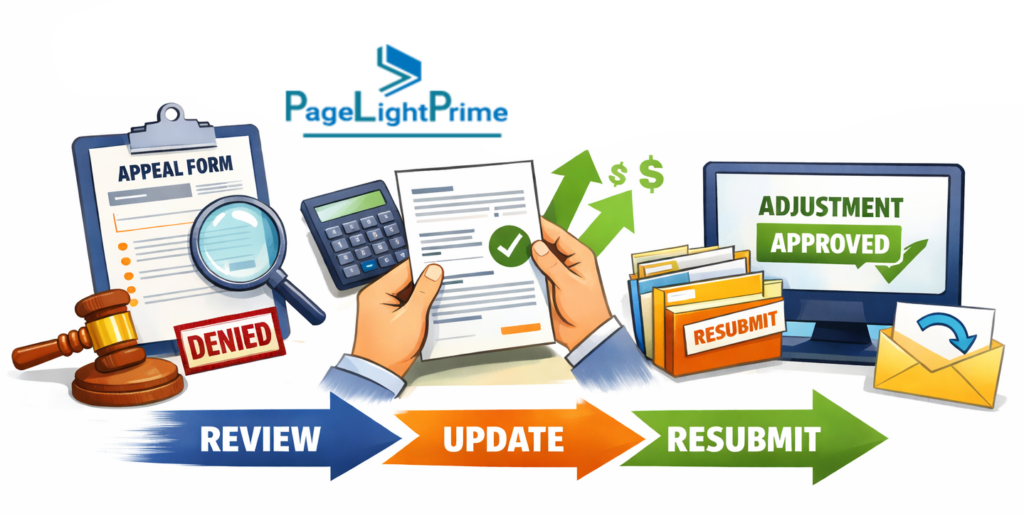
8. Appeals, Adjustments, and Resubmissions
After submission:
- Review reductions and rejections carefully:
- Use standardized appeal templates including:
- Historical approval trends
- Efficiency metrics
- Justification tied to case outcomes or necessity
- Feed rejection reasons back into billing rules and training.
9. Collections and Follow-Up
Ensure timely payment:
- Track invoice lifecycle: submitted → under review → approved → paid → appealed
- Automate reminders based on carrier SLAs and aging receivables
- Monitor payment delays and escalate where necessary
- Feed payment and adjustment data into profitability and performance metrics.
10. Analytics and Continuous Improvement
Use data to refine performance:
- Monitor:
- Realization rates
- Days-to-pay
- Write-offs and reductions
- Carrier-specific rejection patterns
- Use dashboards and reporting tools to:
- Improve budgeting accuracy
- Refine billing practices
- Train attorneys and staff
Continuous improvement reduces friction, accelerates payment, and strengthens carrier relationships.

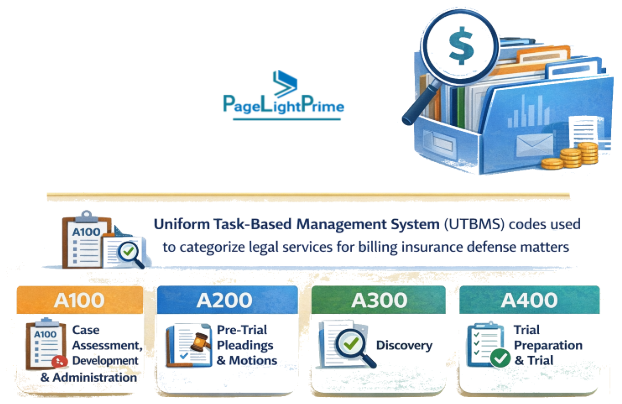
UTBMS Codes in Insurance Defense Billing
Phases (L-codes):
- L100 Case Assessment, Development & Administration
- L200 Pre-Trial Pleadings & Motions
- L300 Discovery
- L400 Trial Preparation & Trial
Task vs Activity vs Expense
- Task codes: What is being done
- Activity codes: How it is being done
- Expense codes: Associated costs
Configuration Tips
- Pre-load full litigation code sets but restrict per carrier
- Limit use of “Other” codes (e.g., L190)
- Use templates for common litigation events:
- Initial reports
- Depositions
- Discovery phases
- Mediation and trial prep
Comprehensive Insurance Defense Narrative with UTBMS Codes
| Narrative Example | UTBMS Phase (L-code) | Task Code | Activity Code | Notes |
|---|---|---|---|---|
| Reviewed insured’s tender letter and attached loss notice to evaluate coverage position and potential panel counsel assignment | L100 Case Assessment | L110 Case Assessment | A101 Review/Analysis | Initial coverage evaluation |
| Reviewed complaint (18 pages) and exhibits to identify causes of action, potential defenses, and removal grounds | L100 Case Assessment | L120 File/Document Review | A101 Review/Analysis | Identify defenses & strategy |
| Reviewed complaint (18 pages) and exhibits to identify causes of action, potential defenses, and removal grounds | L100 Case Assessment | L120 File/Document Review | A101 Review/Analysis | Identify defenses & strategy |
| Analyzed claim file notes and prior correspondence to assess liability exposure and develop initial defense strategy | L100 Case Assessment | L110 Case Assessment | A101 Review/Analysis | Early strategy development |
| Telephone conference with claims adjuster to discuss liability evaluation, settlement authority, and litigation budget for upcoming discovery | L100 Case Assessment | L130 Communications | A103 Phone Call/Meeting | Carrier communication |
| Drafted detailed status report to carrier summarizing case history, recent developments, and recommended next steps | L100 Case Assessment | L130 Communications | A105 Drafting | Written carrier update |
| Reviewed adjuster email regarding reserve increase request and prepared response outlining basis for recommended adjustment | L100 Case Assessment | L130 Communications | A105 Drafting | Written response to adjuster |
| Reviewed and summarized insured’s prior statements and incident report to identify inconsistencies relevant to liability and damages | L100 Case Assessment | L140 Investigation | A101 Review/Analysis | Fact review & evaluation |
| Analyzed medical records (approx. 175 pages) to evaluate causation issues and potential pre-existing conditions | L100 Case Assessment | L140 Investigation | A101 Review/Analysis | Fact & medical assessment |
| Prepared outline of key factual issues for follow-up investigation and potential special interrogatories | L100 Case Assessment | L140 Investigation | A105 Drafting | Prep for discovery investigation |
| Drafted first set of interrogatories and requests for production to plaintiff focused on liability facts, prior claims, and medical history | L300 Discovery | L310 Written Discovery | A105 Drafting | Initial written discovery |
| Reviewed and summarized plaintiff’s responses to interrogatories and production (approx. 250 pages) to identify missing documents and grounds for motion to compel | L300 Discovery | L320 Review of Discovery Responses | A101 Review/Analysis | Identify deficiencies |
| Prepared deficiency letter to opposing counsel identifying incomplete discovery responses and requesting supplementation before motion practice | L300 Discovery | L320 Review of Discovery Responses | A105 Drafting | Document deficiencies formally |
| Reviewed pleadings, discovery responses, and medical records to | L300 Discovery | L330 Depositions | A105 Drafting | Deposition prep |
| Reviewed pleadings, discovery responses, and medical records to prepare outline and exhibits for plaintiff’s deposition | L300 Discovery | L330 Depositions | A105 Drafting | Deposition prep |
| Conducted deposition of plaintiff regarding liability, comparative fault, and alleged injuries; clarified prior inconsistent statements | L300 Discovery | L330 Depositions | A103 Conference/Interview | Deposition testimony |
| Reviewed and annotated deposition transcript to identify admissions supporting dispositive motion and impeachment material for trial | L300 Discovery | L330 Depositions | A101 Review/Analysis | Post-deposition review |
| Researched case law on duty to defend under applicable state law in preparation for summary judgment motion on coverage | L200 Pre-Trial Pleadings & Motions | L210 Motion Drafting | A101 Research | Legal research for motion |
| Drafted motion for summary judgment on liability, including statement of undisputed facts and supporting legal memorandum | L200 Pre-Trial Pleadings & Motions | L210 Motion Drafting | A105 Drafting | Motion preparation |
| Reviewed plaintiff’s opposition and prepared reply brief addressing alleged factual disputes and distinguishing cited authorities | L200 Pre-Trial Pleadings & Motions | L210 Motion Drafting | A105 Drafting | Response brief |
| Prepared for and attended case management conference; addressed discovery schedule, motion deadlines, and mediation timing | L200 Pre-Trial Pleadings & Motions | L220 Hearings & Appearances | A103 Conference/Interview | Court appearances |
| Prepared argument outline and attended hearing on defendant’s motion to compel discovery; obtained order compelling production and limited sanctions | L200 Pre-Trial Pleadings & Motions | L220 Hearings & Appearances | A103 Conference/Interview | Court hearing prep & attendance |
| Attended settlement conference with court; presented liability and damages evaluation and negotiated within authorized settlement range | L400 Trial Preparation & Trial | L410 Settlement & Mediation | A103 Conference/Interview | Court settlement session |
| Prepared detailed mediation brief summarizing facts, liability defenses, medical issues, and settlement range for mediator and carrier | L400 Trial Preparation & Trial | L410 Settlement & Mediation | A105 Drafting | Written mediation prep |
| Participated in half-day mediation; evaluated plaintiff’s settlement demands, conferred with adjuster regarding authority, and negotiated toward resolution | L400 Trial Preparation & Trial | L410 Settlement & Mediation | A103 Conference/Interview | Mediation participation |
| Drafted and revised settlement agreement and release to reflect negotiated terms and protect insured and carrier interests | L400 Trial Preparation & Trial | L410 Settlement & Mediation | A105 Drafting | Formalize settlement |
| Prepared witness lists, exhibit lists, and trial binders, including organizing key deposition excerpts and demonstrative exhibits | L400 Trial Preparation & Trial | L420 Trial Preparation | A105 Drafting | Trial prep materials |
| Met with insured and fact witnesses to review testimony, exhibits, and trial strategy in advance of appearance | L400 Trial Preparation & Trial | L420 Trial Preparation | A103 Conference/Interviewprep | Witness prep |
| Coordinated with defense experts regarding opinions, trial demonstratives, and testimony outline | L400 Trial Preparation & Trial | L420 Trial Preparation | A103 Conference/Interview | Expert coordinationprep |
| Updated internal and carrier matter plans and budgets to reflect current discovery schedule and anticipated motion practice | L100 Case Assessment | L150 Administration | A107 Administrative | Often non-billable or internal |
| Reviewed invoice draft for compliance with carrier billing guidelines and corrected descriptions and codes as needed | L100 Case Assessment | L150 Administration | A105 Drafting | Ensure billing compliance |
The “Banned Words” & Phrases Registry
To maximize realization, replace passive or administrative language with active, outcome-oriented descriptions.
1. The “Administrative” Trap
Carriers rarely pay for clerical work. If a task sounds like “office overhead,” it will be cut.
| ❌ Banned/Weak Phrase | ✅ Recommended Replacement | Why? |
|---|---|---|
| “Filed documents” | “Prepared and processed [Document Name] for electronic filing per court rules.” | “Filing” is seen as a secretarial task. |
| “Organized file” | “Categorized and indexed 250+ pages of medical records for causation analysis.” | Organization must serve a specific legal purpose. |
| “Mailling/Faxing” | “Served [Document] via [Method] to all parties of record.” | Service is a legal requirement; mailing is a chore. |
| “Updated calendar” | “Calculated and calendared discovery deadlines following Case Management Order.” | Calendaring is a high-level risk management task. |
2. The “Vague Activity” Trap
Vague entries imply “padding.” Be specific about the what and the why.
| ❌ Banned/Weak Phrase | ✅ Recommended Replacement | Why? |
|---|---|---|
| “Worked on file” | “Analyzed [Specific Document] to identify potential impeachment evidence.” | “Worked on” tells the carrier nothing about the value. |
| “Research” | “Conducted legal research regarding [Specific Issue] for MSJ preparation.” | Research must be tied to a specific deliverable. |
| “Review email” | “Analyzed email from [Party] regarding [Subject] to determine impact on [Strategy].” | “Review” is passive; “Analyze” is professional. |
| “Trial prep” | “Drafted witness examination outline for [Name] and organized related exhibits.” | “Trial prep” is too broad and looks like a “dump” code. |
3. The “Internal/Duplicative” Trap
Carriers hate paying for your internal firm meetings.
| ❌ Banned/Weak Phrase | ✅ Recommended Replacement | Why? |
|---|---|---|
| “Interoffice conference” | “Conferred with [Name] regarding [Specific Strategy/Task] to ensure [Result].” | Use “Confer” and focus on the outcome of the meeting. |
| “Attention to…” | Delete and start with a verb. (e.g., “Drafted…” or “Reviewed…”) | “Attention to” is fluff that triggers AI audit flags. |
| “Meeting with staff” | “Delegated [Specific Task] to [Timekeeper] to ensure cost-efficient handling of [Matter].” | Frame it as a cost-saving or efficiency measure. |
Implementation Tip: The “Narrative Formula”
Pre-Bill Review Checklist (Insurance Defense Focused)
Structural & Code Compliance
- All required fields present (client/matter, date, timekeeper, hours, rate, UTBMS codes)
- No restricted or invalid codes
- Rates align with agreements
Carrier Guideline Alignment
- Correct time increments
- No block billing
- Travel and admin time compliant with rules
Narrative Quality
- Clear, outcome-driven descriptions
- Avoid vague terms (e.g., replace “worked on case” with specific actions)
- Proper handling of sensitive strategy descriptions
Reasonableness & Duplication
- Proportional time for tasks
- No duplication without justification
- Alignment with budget and litigation phase
Final LEDES Readiness
- All validations passed
- Proper formatting and grouping
- Prior rejection issues addressed
Key Controls and Best Practices
- Standardized templates and narratives: Ensure consistent, compliant time entries
- Automation and integrations: Reduce manual errors and accelerate billing cycles
- Training and feedback loops: Reinforce compliance and improve habits
- Pre-approval workflows: Avoid post hoc write-offs for high-cost items
Use billing systems that support insurance defense requirements such as UTBMS coding, LEDES format, multi-payor billing, and multiple rate agreements (for example, legal accounting platforms like PageLightPrime

Roles and Responsibilities
- Timekeepers: Enter detailed, compliant time and expenses in real time
- Billing staff: Maintain rules, run audits, manage submissions, handle appeals
- Billing attorneys/partners: Oversee pre-bill review, narratives, and strategy
- Finance/management: Monitor profitability, realization, and cash flow
Example Monthly Cycle
For an active panel counsel matter:
- Days 1–25: Daily time entry with real-time compliance checks
- Days 26–28: Pre-bill generation and automated audits
- Days 28–30: Attorney review, approval, LEDES export, submission
- Following month: Monitor status, address reductions, appeal, and post payments
Small Comparison: Core Elements
| Element | What it controls | Why it matters in insurance defense |
|---|---|---|
| LEDES format | File structure and invoice fields | Enables automated carrier processing |
| UTBMS coding | Classification of work and expenses | Standardizes billing across firms |
| Time tracking | Capture of billable activity | Reduces leakage and improves accuracy |
| Pre-bill review | Final quality control | Prevents rejections and delays |
“
Final Thoughts
A structured insurance defense billing workflow transforms complex processes into repeatable, efficient systems. By integrating careful matter setup, disciplined time capture, UTBMS and LEDES compliance, automated validation, and rigorous pre-bill review, firms can:
- Minimize rejections
- Improve cash flow
- Increase realization
- Strengthen carrier relationships
Billing becomes a strategic lever for profitability, compliance, and client satisfaction—not just an administrative task. Firms that implement a structured insurance defense billing workflow with UTBMS coding, LEDES billing format, and carrier guideline enforcement consistently achieve higher realization and faster payment.
Firms that follow insurance defense billing best practices, enforce carrier billing guidelines, use UTBMS codes correctly, and submit LEDES-compliant invoices through legal e-billing platforms consistently achieve higher realization and fewer billing rejections.

“
FAQ – Insurance Defense Billing
What are UTBMS codes in insurance defense billing?
UTBMS (Uniform Task-Based Management System) codes are standardized billing codes used by insurance carriers to classify legal work.
They include:
- L-codes for litigation phases
- Task codes for specific work
- Activity codes for how work is performed
- Expense codes for costs
UTBMS codes allow carriers to review invoices automatically and compare billing across law firms.
What is LEDES billing format?
LEDES (Legal Electronic Data Exchange Standard) is a standardized file format used to submit legal invoices to insurance carriers and corporate clients.
Common formats include:
- LEDES 1998B
- LEDES 2000
- LEDES XML
LEDES billing ensures invoices can be processed automatically by e-billing platforms such as TyMetrix, CounselLink, and Legal Tracker.
Why do insurance carriers reject legal invoices?
Insurance carriers reject invoices when billing does not comply with guidelines, such as:
- Missing UTBMS codes
- Block billing.
- Non-approved timekeepers
- Rates above agreement
- Administrative tasks billed
- Invalid LEDES format
- Work outside budget
Using automated billing validation and pre-bill review reduces rejections.
What is block billing in insurance defense?
Block billing is when multiple tasks are combined into one time entry instead of listing each task separately.
Example of block billing:
Review file, draft motion, email client, prepare discovery – 5.5 hours
Most insurance carriers prohibit block billing because it prevents accurate review of work.
Best practice is to record each task separately with correct UTBMS codes.
What is pre-bill review in insurance defense billing?
Pre-bill review is the quality-control step before invoices are submitted to the carrier.
During pre-bill review, firms check:
- UTBMS codes
- Rates
- Narratives
- Compliance with guidelines
- Budget alignment
- Duplicate entries
- Billing caps
Pre-bill review prevents invoice rejection and improves realization.
What are insurance carrier billing guidelines?
Carrier billing guidelines are rules issued by insurance companies that control how law firms bill for work.
Guidelines may include:
- Approved hourly rates
- Allowed UTBMS codes
- Time entry format
- Billing increments
- Limits on travel time
- Restrictions on administrative tasks
- Budget requirements
- Staffing rules
Firms must follow these rules for invoices to be approved.
What is legal e-billing in insurance defense?
Legal e-billing is the electronic submission of invoices to insurance carriers through billing platforms.
Common e-billing systems include:
- TyMetrix
- CounselLink
- Legal Tracker
- Serengeti
- Collaborati
E-billing systems automatically review invoices for guideline compliance before approval.
How can law firms reduce billing rejections from insurance carriers?
Law firms can reduce rejections by:
- Using UTBMS codes correctly
- Enforcing carrier rules in law firm billing software
- Avoiding block billing
- Performing pre-bill review
- Using LEDES-compliant exports
- Training timekeepers on narratives
- Monitoring reductions and appeals
Automation and standardized workflows significantly improve billing success.
Why are billing narratives important in insurance defense?
Billing narratives explain the purpose and value of the work performed.
Strong narratives should:
- Use active verbs
- Describe the task clearly
- Show the legal purpose
- Avoid administrative wording
- Follow carrier guidelines
Poor narratives are one of the most common reasons invoices are reduced.
What is realization in insurance defense billing?
Realization is the percentage of billed time that is actually paid by the insurance carrier.
Low realization happens when:
- invoices are reduced
- time is written off
- entries are rejected
- guidelines are violated
Strong billing workflows improve realization and cash flow.
How often should insurance defense bills be submitted?
Most insurance defense matters follow a monthly billing cycle:
- Daily time entry
- End-of-month pre-bill review
- Monthly LEDES submission
- Carrier review
- Payment or reduction
- Appeals if needed
Submitting bills regularly improves cash flow and reduces disputes.