
Multi Payor Multi Rate Legal Billing: Complete Guide
Multi payor legal billing is the process of billing a single legal matter to multiple insurers or payors, each with different rates, billing rules, and compliance requirements. It is commonly used in insurance defense law firms handling cases with multiple carriers.
Multi payor legal billing is rarely simple—but in insurance defense and panel billing environments, it becomes especially intricate. One of the most challenging scenarios firms face today is managing multiple payors, each with different rate structures, billing rules, and compliance requirements—all within a single matter.
Written by Knowledge Team, posted on March 24, 2026
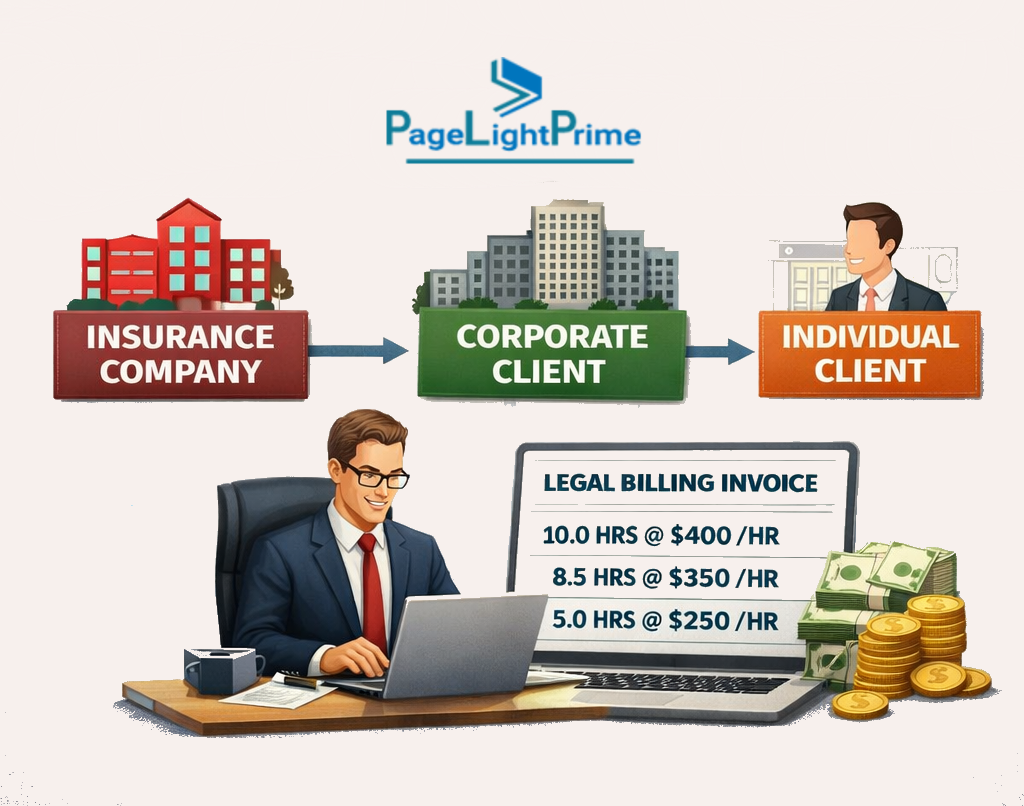
If you’re dealing with multiple insurance carriers in a single case, each with their own billing guidelines and negotiated rates, you already know: this isn’t something most systems handle gracefully. In fact, multi-payor legal billing remains one of the most under-supported areas in traditional billing systems, despite being a common real-world requirement.
At its core, this is the challenge of legal billing multiple clients one matter—where a single legal matter must support multiple financial relationships, each with its own expectations, formats, and constraints. It’s not just a billing problem; it’s a structural limitation in how most systems are designed,
Key Takeaways
- Multi payor legal billing involves billing a single legal matter to multiple insurers or payors
- Each payor may have different hourly rates, billing rules, allocation methods, and invoice formats
- This creates significant complexity, especially in insurance defense and panel billing environments
- Most traditional billing systems cannot support multi payor legal billing natively
- Specialized insurance defense billing software or legal billing compliance software is typically required to manage this effectively
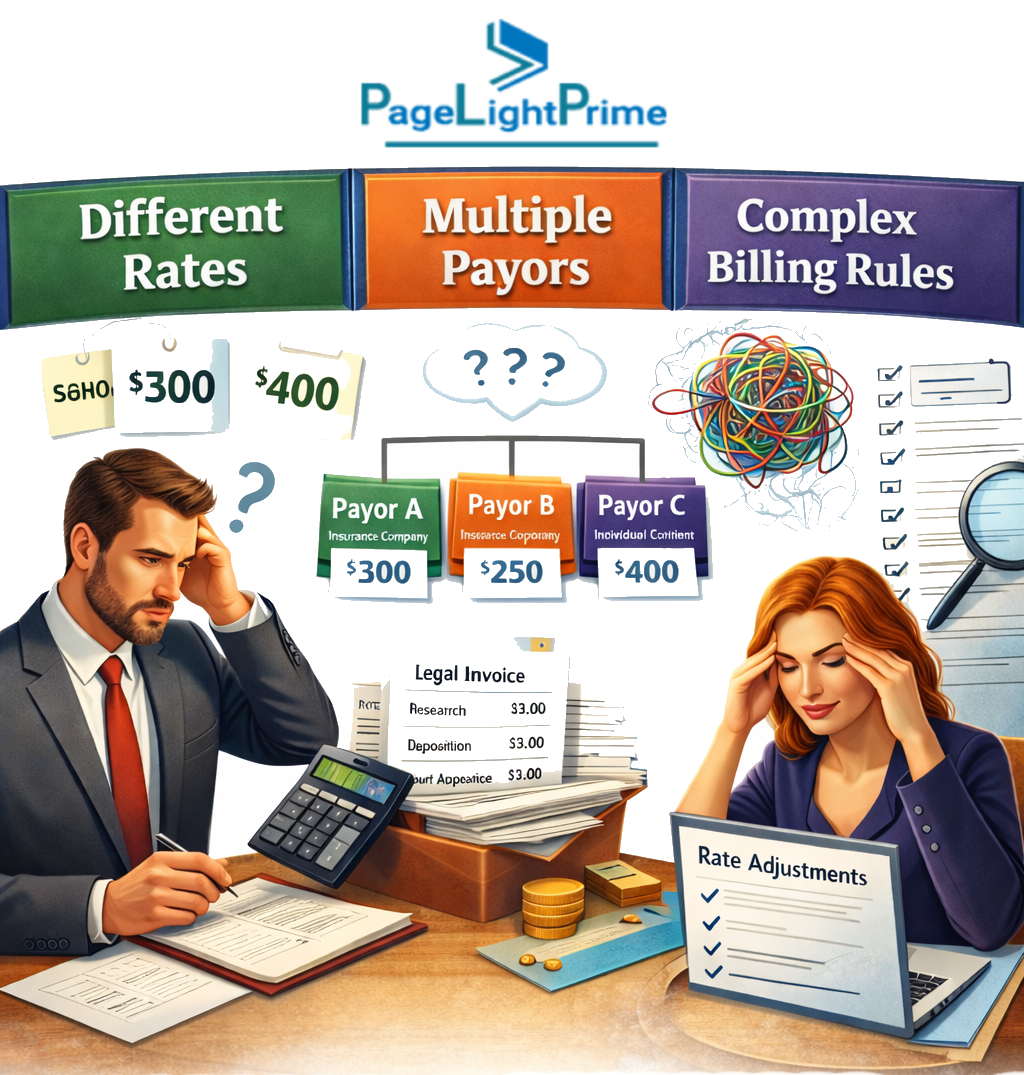
Multi Payor Legal Billing vs Split Billing
Although multi-payor legal billing (also called multi-payer billing) and split billing are often used interchangeably, they represent fundamentally different billing models. Understanding the difference is critical—especially for insurance defense law firms handling complex matters with multiple carriers.
Multi Payor vs Split Billing (Quick Definition)
- Split billing divides a single invoice across multiple payors using the same rules.
- Multi payor legal billing manages independent billing logic, rate structures, and compliance requirements for each payor within the same matter.
This distinction is critical because most traditional billing systems only support split billing—not true multi payor legal billing.
Key Difference (At a Glance)
- Split billing divides a single invoice among multiple payors, usually using the same rate structure and billing rules.
- Multi payor legal billing involves billing multiple payors independently within the same matter, each with different rates, billing guidelines, compliance requirements, and invoice formats.
Side-by-Side Comparison
The table below highlights the key differences between multi payor legal billing and split billing:
| Feature | Multi Payor Legal Billing | Split Billing |
|---|---|---|
| Rate Structures | Different rates per payor for the same time entry | Same rates applied across all payors |
| Billing Rules | Payor-specific billing guidelines and restrictions | Shared rules across the invoice |
| Invoice Generation | Separate, fully compliant invoices per payor | One invoice split across payors |
| Compliance (LEDES, UTBMS) | Enforced individually per payor | Applied uniformly |
| Allocation Methods | Percentage, time-based, or hybrid models | Typically percentage-based only |
| Use Case Complexity | High (insurance defense, multi-carrier cases) | Low to moderate |
| System Requirements | Advanced legal billing compliance software | Basic billing systems often sufficient |
Why the Difference Matters
In simple billing scenarios, split billing may be enough. However, in insurance defense environments, where multiple insurers are involved in a single matter, split billing quickly becomes insufficient.
For example:
- One carrier may require LEDES 1998B, while another requires LEDES XML
- Each payor may enforce different UTBMS coding rules
- The same attorney’s time may be billed at different negotiated rates
These requirements cannot be handled by basic invoice splitting alone.
When to Use Each Model
Use Split Billing when:
- Payors share the same billing rules and rates
- The invoice structure is simple
- Compliance requirements are minimal

Use Multi Payor Legal Billing when:
- Each payor has different rate agreements
- Billing guidelines vary by carrier
- Separate invoices and formats are required
- Compliance (LEDES, UTBMS) must be enforced individually
Bottom Line
Split billing is a simplified approach to dividing costs.
Multi payor legal billing is a comprehensive billing framework for managing multiple payors, rate structures, and compliance requirements within a single legal matter.
For law firms handling insurance defense or panel counsel work, multi payor legal billing is not just an enhancement—it is a necessity.

Why Multi Payor Legal Billing Is Complex
The requirement involves several overlapping layers of complexity:
- Multiple carriers assigned to a single matter
- Each carrier having:
- Its own negotiated hourly rates
- Unique billing rules and guidelines
- UTBMS task and activity code requirements
- LEDES formatting expectations
- Allocation logic (percentage-based or time-based)
- The need to generate separate, fully compliant invoices per carrier

This setup is common in insurance defense firms—but it breaks the assumptions most billing systems were built on.
Most platforms were designed around a much simpler model:
One client → one rate structure → one invoice
That model works well for straightforward billing scenarios. But once you introduce multiple payors with different rules into a single matter, the system doesn’t just stretch—it breaks.
This is why multi payor legal billing is not just a feature gap. It’s an architectural challenge.

Real-World Use Case: Multi Payor Legal Billing in Practice
To fully understand the complexity of multi payor legal billing, it helps to look at a realistic scenario that many insurance defense firms encounter.
Consider a law firm handling a construction liability case involving multiple defendants and layered insurance coverage. In this case, three separate insurance carriers are responsible for funding the defense, each covering a defined portion of the exposure.
At first glance, this may appear to be a straightforward split billing law firm scenario. But in practice, it introduces multiple overlapping requirements that significantly increase billing complexity.
Each insurer may require:
- Different negotiated hourly rates for the same attorneys and staff
- Unique billing guidelines, including restrictions on tasks and time entries
- Strict adherence to UTBMS task and activity codes
- Specific invoice formats, often requiring different versions of LEDES (such as 1998B or XML)
- Independent invoice review and approval workflows
- Distinct allocation models—some percentage-based, others tied to specific work performed
Now consider what happens when a single attorney logs time on the matter.

That one time entry may need to be:
- Allocated across multiple carriers
- Billed at different rates depending on the payor
- Evaluated against multiple sets of billing rules
- Included in separate invoices, each formatted and structured differently
This is the operational reality of legal billing multiple clients one matter. It highlights why multi payor legal billing cannot be handled with basic billing tools or simple invoice-splitting features.

Without a system designed for this level of complexity, firms often rely on:
- Manual allocation calculations
- Spreadsheet-based billing adjustments
- Repeated invoice edits and resubmissions
- Ongoing coordination between billing teams and attorneys
Over time, these workarounds introduce risk. Errors become more likely, compliance gaps increase, and billing cycles slow down.
This is also where robust LEDES billing software capabilities and legal billing compliance software functionality become essential. Without them, even well-managed firms can struggle to meet carrier requirements consistently.

Do Legal Billing Systems Support Multi Payor Billing?
Yes—but not universally.
Only more advanced or purpose-built insurance defense billing software truly supports this level of complexity in a scalable and reliable way.
A commonly available features in legal software incldues:
- Split billing across multiple payors
- Allocation by percentage or individual time entries
- Different hourly rates per payor
However, it’s important to look beyond surface-level functionality. Many tools positioned as split billing law firm solutions offer only partial support. They may allow invoices to be divided across payors, but still rely on a single rate structure or require manual intervention to meet compliance requirements.
True multi payor legal billing requires a system that can manage multiple billing logics simultaneously—without compromising accuracy, efficiency, or compliance.
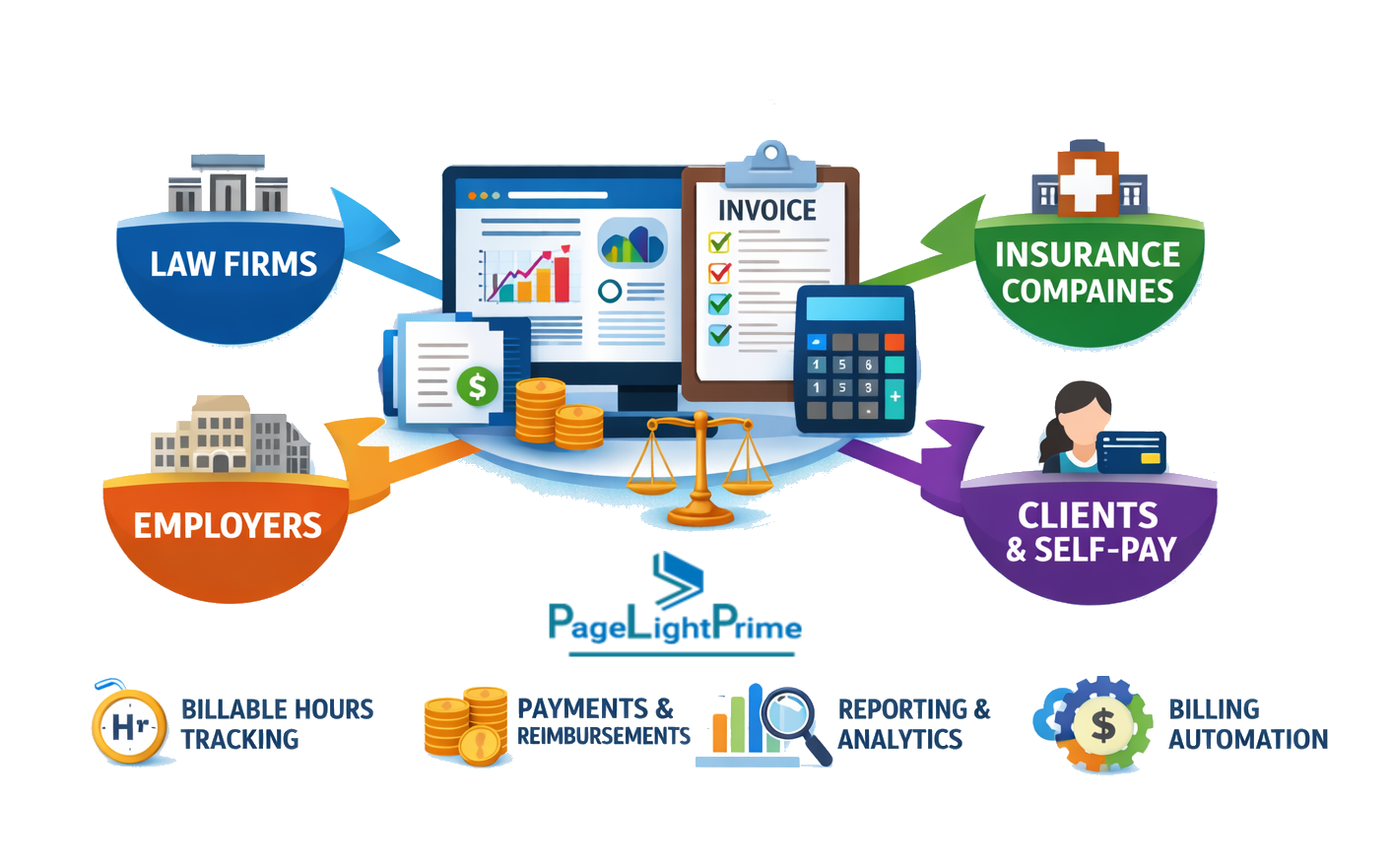
Key Features of Multi Payor Legal Billing Software
Platforms that genuinely support multi payor legal billing include several critical capabilities. Without these, firms are forced into inefficient and error-prone workarounds.
Multi-Payor Configuration
At a foundational level, the system must allow multiple payors to be associated with a single matter, along with flexible allocation rules.
This includes:
- Percentage-based allocation (e.g., Carrier A = 40%, Carrier B = 35%, Carrier C = 25%)
- Time-based allocation, where specific tasks or entries are assigned to individual carriers
More advanced systems support hybrid models, where both allocation types are used together. This flexibility is essential for firms managing legal billing multiple clients one matter across diverse case types.
Rate Tables
Each payor must have its own configurable rate structure.
This typically includes:
- Timekeeper-specific billing rates
- Task-based or activity-based rate variations
- Overrides based on matter type or jurisdiction
Without this level of control, firms cannot accurately reflect negotiated rates. This leads to billing discrepancies, increased write-downs, and potential disputes with carriers—all of which undermine the effectiveness of multi payor legal billing.
Invoice Automation
A modern billing engine must go beyond basic invoice generation and support intelligent automation.
Key capabilities include:
- Automatic allocation of work-in-progress (WIP) across multiple payors
- Application of correct rate structures for each carrier
- Generation of separate invoices for each payor
- Output in required formats, including LEDES
This is where strong LEDES billing software capabilities become critical. Insurance carriers often enforce strict formatting standards, and even minor deviations can result in invoice rejection.
Compliance (LEDES, UTBMS)
Compliance is a central requirement in insurance defense billing—not an optional feature.
Advanced systems function as legal billing compliance software, enforcing:
- Carrier-specific billing guidelines
- Time entry restrictions and approval rules
- UTBMS task and activity code standards
- Audit-ready invoice structures
Without embedded compliance controls, multi payor legal billing workflows become difficult to manage at scale, increasing the likelihood of errors, delays, and rejected invoices.

Limitations of Most Billing Software
Despite growing demand, many billing systems still provide only partial support for multi payor legal billing.
- “Split billing” features that apply the same rate across all payors
- Dependence on manual processes for allocation and adjustments
- Lack of a true multi-rate billing engine
- Inconsistent or limited support for LEDES formats
- Minimal enforcement of billing guidelines and compliance rules
These limitations are particularly evident in legacy or generalized insurance defense billing software, where the underlying system architecture was never designed to handle this level of complexity.
As billing requirements grow more sophisticated, these gaps lead to increased administrative effort, slower billing cycles, and greater financial risk.
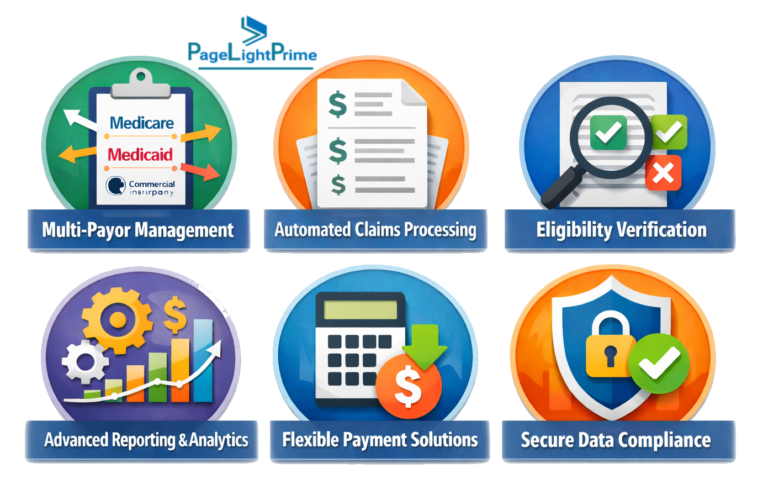
How to Evaluate Vendors
If you’re evaluating billing or legal accounting solutions for multi payor legal billing, asking the right questions is essential.
These questions help distinguish between superficial feature support and true system capability:
- Can a single time entry be billed at different rates to different payors?
- Are invoices automatically generated per carrier, each with its own format and compliance rules?
- Does the system fully support LEDES 1998B and XML formats for different payors?
- Can billing rules and restrictions vary by payor within the same matter?
- Is allocation configurable as percentage-based, time-based, or a hybrid of both?
- How are write-downs, edits, and adjustments managed across multiple carriers?
Very few systems can confidently meet all of these requirements.
And that is precisely what makes multi payor legal billing such a critical evaluation area when selecting legal billing compliance software.

Legal Accounting and Billing Platforms for Insurance Defense
Very few systems are designed from the ground up to handle multi payor legal billing in complex, high-volume environments.
In practice, solutions that support this level of billing typically fall into several categories:
- General legal billing tools with basic split billing capabilities
- Insurance defense billing software designed for carrier-driven workflows
- Legal accounting platforms with integrated billing and compliance functionality
Legal practice management software in the latter categories are more likely to provide:
- True multi-payor configuration at the matter level
- Support for different rate structures per payor
- Automated invoice generation with payor-specific logic
- Built-in compliance aligned with LEDES and UTBMS standards

Some modern insurance defense legal practice management software—such as PageLightPrime—are designed to combine legal accounting, law firm billing automation, and compliance within a unified system.
These platforms aim to reduce reliance on manual processes by:
- Automating allocation and rate application
- Generating carrier-specific, compliant invoices
- Enforcing billing rules at the system level
For firms operating in insurance defense, the key consideration is not just whether a system supports multi payor legal billing, but how effectively it does so in real-world scenarios.

In simple terms
- Basic billing tools → Split invoices across multiple payors, often using the same rates and limited logic
- Advanced legal billing platforms → Manage true multi payor legal billing by handling multiple rate structures, billing rules, allocation methods, and compliance requirements simultaneously within the same matter
Multi payor legal billing is not just invoice splitting—it is managing multiple billing systems simultaneously.
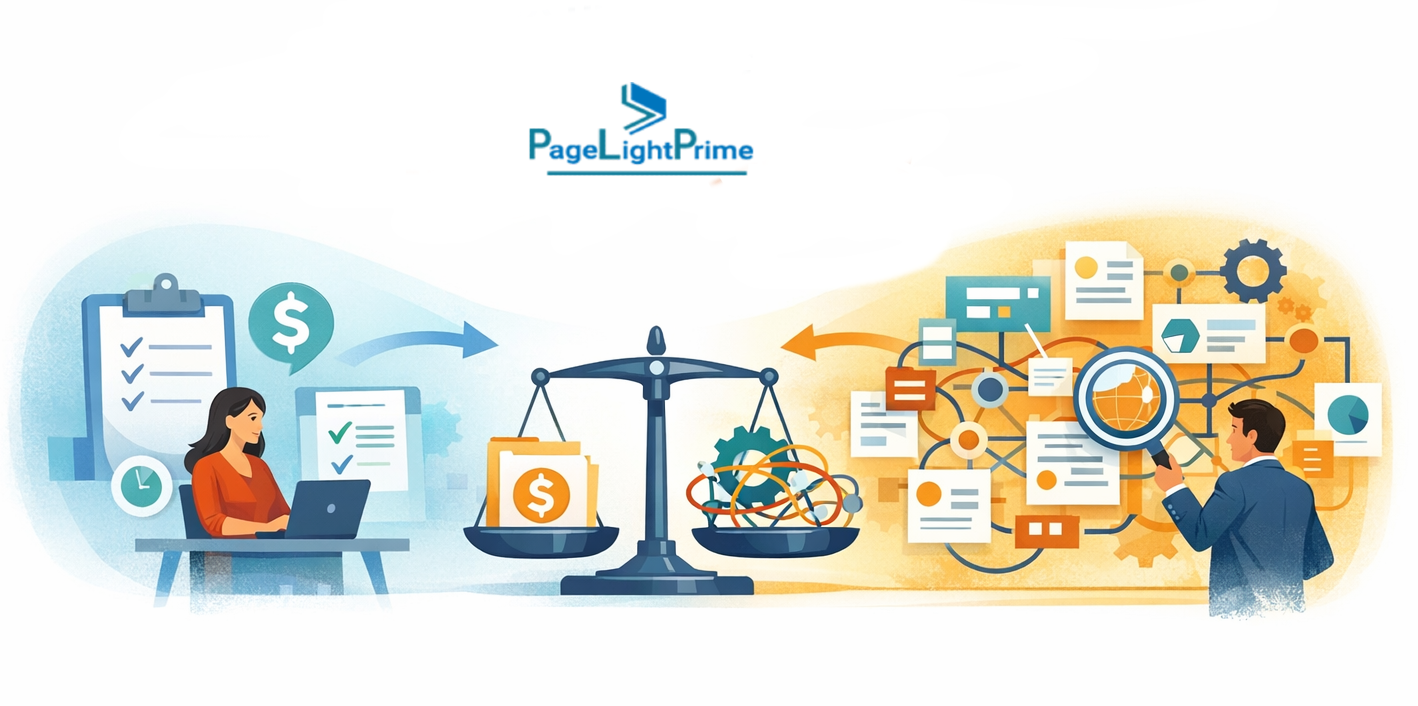
Comparison: Modern Legal Billing Platforms vs Traditional Tools
When evaluating solutions for multi payor legal billing, the differences between purpose-built systems and traditional tools become much clearer when viewed side by side.
| Capability | Modern Legal Billing Platforms (e.g., PageLightPrime) | Typical Legal Billing Software |
|---|---|---|
| Multi Payor Legal Billing | Native support for multiple payors within a single matter, each with independent logic | Basic split billing; often limited to simple allocation |
| Multiple Rates per Payor | Fully supports different rates per payor for the same time entry | May support different rates, but often lacks true multi-rate application |
| Legal Billing Multiple Clients One Matter | Designed specifically for this scenario with flexible allocation models | Supported in limited ways; often requires manual adjustments |
| Allocation Methods | Percentage-based, time-based, and hybrid models in the same matter | Typically supports only one method at a time |
| Invoice Generation | Automatically generates separate, carrier-specific invoices with correct rules applied | Can split invoices, but often requires manual review |
| LEDES Billing Software Support | Built-in support for multiple LEDES formats per payor | Supports LEDES, but often not at a per-payor level |
| Compliance Enforcement | Embedded legal billing compliance software with rule enforcement per carrier | Limited or partially manual compliance handling |
| UTBMS Coding | Enforced and validated per payor automatically | Supported, but validation may require manual checks |
| Automation Level | High—end-to-end automation across billing workflows | Moderate—partial automation with manual dependencies |
| Manual Work Required | Minimal | Common in complex billing scenarios |
| Best Fit | Insurance defense firms with complex billing needs | Firms with simpler billing requirements |
Best Setup for Your Firm
If your firm is currently using a mix of billing tools, general accounting software, and shared systems for matter management, you’re not alone. This fragmented setup is common—and often the starting point before firms move toward more specialized solutions.
As billing complexity increases—especially with multi payor legal billing—these disconnected systems begin to show their limitations. Manual coordination increases, data consistency becomes harder to maintain, and compliance risks grow.
Many firms today also rely heavily on Microsoft 365 for collaboration, document management, and communication. While it provides a strong operational foundation, it typically lacks the specialized capabilities required for complex legal billing workflows.

Firms navigating this transition typically move toward one of two approaches:
Option 1: Integrated System
- All-in-one platform
- Simpler workflows
- Less flexibility
Option 2: Best-of-Breed (Recommended for complex firms)
- Specialized billing system
- Strong compliance
- Better scalability
- Integration with Microsoft 365
👉 Integrated Practice Management + Billing
A unified platform that combines legal matter management,, billing, and accounting into a single system.
This approach offers:
- Centralized data across matters, billing, and financials
- Simplified workflows with fewer system handoffs
- Easier reporting and visibility across the firm
However, for firms with complex requirements—such as legal billing multiple clients one matter—it’s important to ensure the platform has strong, built-in support for multi payor legal billing, not just basic billing functionality.
👉 Best-of-Breed Billing + Legal Accounting
A specialized billing and legal accounting solution designed specifically for complex billing environments, often integrated with existing tools like Microsoft 365 for document and workflow management.
This approach provides:
- Greater flexibility in handling multi payor legal billing
- More advanced support for rate structures, allocation models, and compliance
- Stronger capabilities typically found in insurance defense billing software
- The ability to leverage existing Microsoft 365 investments for collaboration and document control
It is often the preferred option for firms dealing with high volumes of split billing law firm scenarios or strict carrier requirements, where billing precision and compliance are critical.

Choosing the Right Approach
The right setup depends on the complexity of your billing workflows.
If your firm handles relatively straightforward billing, an integrated system may be sufficient.
But if you regularly manage:
- Multiple payors per matter
- Different rates per carrier
- Strict LEDES and UTBMS requirements for insurance defense billing
- Complex allocation and compliance rules

—then investing in a solution purpose-built for multi payor legal billing becomes essential.
For firms already operating within the Microsoft 365 ecosystem, an additional consideration is how well a billing platform integrates with that environment. Solutions like PageLightPrime, which are built to work seamlessly within Microsoft 365 for law firms, can extend existing legal workflows rather than replace them—reducing disruption while adding the specialized capabilities required for complex billing.
In these environments, the goal is not just efficiency—it’s ensuring that billing is accurate, compliant, and scalable as your firm grows.
“
Conclusion
Multi payor legal billing is supported today—but only by systems specifically designed to handle its complexity.
For insurance defense firms, this capability is not optional. It is fundamental to efficient, accurate, and compliant billing operations.
Choosing the wrong system can lead to:
- Manual workarounds and inefficiencies
- Increased compliance risk
- Invoice rejections and payment delays
- Ongoing revenue leakage
Choosing the right legal billing compliance software—especially a platform like PageLightPrime that fully supports multi payor legal billing—can transform billing into a streamlined, reliable, and audit-ready process.
In increasingly complex legal environments, that difference is not just operational—it is strategic.

“
FAQ: Frequently Asked Questions
How is multi-payor billing different from split billing?
Split billing typically divides an invoice across multiple payors using the same rate structure.
Multi-payor legal billing goes further by supporting:
- Different rates per payor
- Independent billing rules
- Separate compliance requirements
- Distinct invoice formats (e.g., LEDES)
This makes multi-payor billing significantly more complex.
Why is multi-payor legal billing so complex?
Multi-payor legal billing is complex because it requires managing multiple billing systems within a single matter.
Each payor may have:
- Unique hourly rates
- Different billing guidelines
- Specific UTBMS coding requirements
- Separate invoice formats
A single time entry may need to be:
- Allocated across multiple payors
- Billed at different rates
- Validated against different rules
What industries use multi-payor legal billing?
Multi-payor legal billing is most commonly used in:
- Insurance defense law firms
- Litigation involving multiple insurers
- Panel counsel environments
- Complex commercial litigation
It is especially common where multiple insurance carriers share liability.
Can traditional legal billing software handle multi-payor billing?
Most traditional legal billing systems cannot fully support multi-payor legal billing.
They typically:
- Apply a single rate structure
- Require manual allocation
- Lack compliance enforcement
- Offer limited LEDES support
Firms often need specialized legal billing compliance software or insurance defense billing software.
What features are required for multi-payor legal billing?
A system must include:
- Multi-payor matter configuration
- Payor-specific rate tables
- Automated allocation (percentage or time-based)
- Separate invoice generation per payor
- LEDES billing support
- UTBMS code validation
- Built-in compliance enforcement
What is LEDES billing and why is it important?
LEDES (Legal Electronic Data Exchange Standard) is a standardized format used by insurers to review legal invoices.
It is critical in multi-payor legal billing because:
- Each payor may require a different LEDES format
- Non-compliant invoices are often rejected
- It ensures structured, auditable billing data
What are UTBMS codes in legal billing?
UTBMS (Uniform Task-Based Management System) codes classify legal work into standardized categories.
They are important because:
- Insurance carriers require them
- They enable billing validation
- They support compliance and reporting
How do you allocate billing across multiple payors?
Allocation in multi-payor legal billing can be:
- Percentage-based (e.g., 40% / 30% / 30%)
- Time-based (specific tasks assigned to payors)
- Hybrid models (combining both methods)
Advanced systems automate this process to reduce errors.
Can one time entry be billed at different rates?
Yes. In true multi-payor legal billing, a single time entry can be billed at different rates depending on the payor.
This requires:
- Multiple rate tables
- Automated billing logic
- System-level support
Most basic billing tools cannot handle this.
What is legal billing compliance software?
Legal billing compliance software ensures that invoices follow:
- Carrier-specific billing rules
- Time entry restrictions
- UTBMS standards
- LEDES formatting requirements
It helps reduce:
- Invoice rejections
- Compliance risks
- Manual review effort
What are common challenges in multi-payor billing?
Common challenges include:
- Manual allocation errors
- Rate inconsistencies
- Invoice rejections
- Compliance failures
- Slow billing cycles
These issues often arise when systems are not designed for multi-payor workflows.
How do law firms manage multi-payor billing today?
Firms typically use one of three approaches:
- Manual processes (spreadsheets + adjustments)
- Basic billing software with limited split billing
- Advanced legal billing platforms with automation
The third option is the most scalable and reliable.
What should you look for in multi-payor billing software?
Key evaluation criteria include:
- Support for multiple rates per payor
- Automated invoice generation
- Full LEDES format support
- Built-in compliance rules
- Flexible allocation models
- Minimal manual intervention
Is multi-payor legal billing worth the investment?
Yes—especially for insurance defense firms.
The right system can:
- Reduce administrative workload
- Improve billing accuracy
- Speed up payments
- Ensure compliance
- Prevent revenue leakage