
PASS: The PageLightPrime AI Scoring System for Prioritizing AI and Automation in Legal Workflows
The primary challenge facing legal organizations is no longer determining whether AI can perform a task.
The more important question is:
Which legal workflows should our organization prioritize for AI or automation?
Not every time-consuming task is a viable candidate for AI. Some workflows require substantial human judgment and contextual nuance. Others occur too infrequently to justify implementation costs. Some are highly repetitive but have limited business impact. Others offer substantial productivity gains but carry significant legal, financial, regulatory, or ethical risk.
Written by Knowledge Team, posted on August 21, 2026
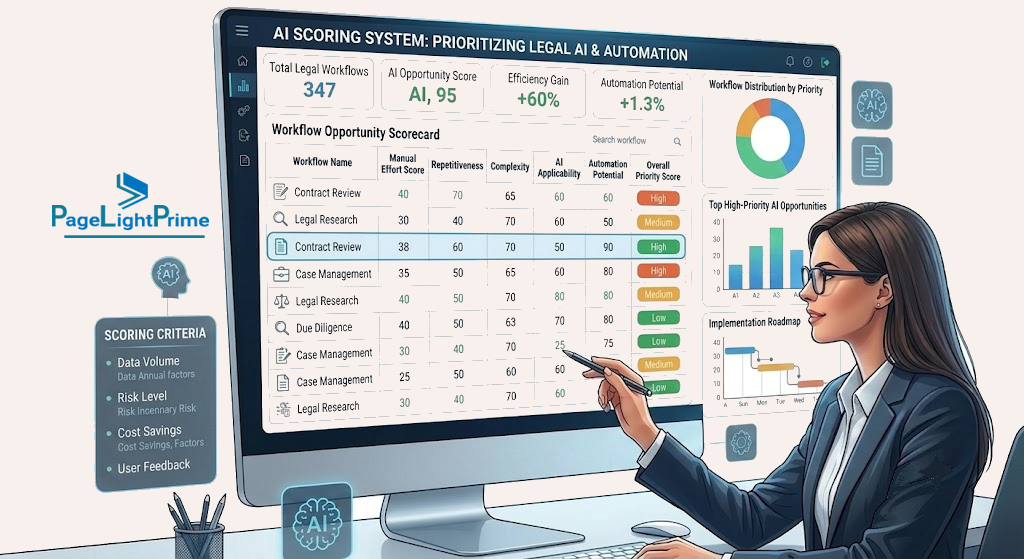
To address this challenge, PageLightPrime introduces the PageLightPrime AI Scoring System (PASS)—a structured and repeatable framework for evaluating and prioritizing legal workflows for AI and automation.
PASS is intended as a decision-support and prioritization framework, not as a statistically validated predictor of ROI or AI implementation success.
TL;DR
PASS (PageLightPrime AI Scoring System) helps law firms and corporate legal departments identify which workflows may offer the greatest opportunities for AI or automation.
PASS evaluates each workflow across six dimensions:
- Time Intensity — How much professional time does the workflow consume?
- Manual Effort — How much of the process is performed manually?
- Frequency — How often does the workflow occur?
- Standardization — How consistently can the workflow be performed?
- AI/Automation Fit — How well does the workflow align with available technology?
- Business Impact — What value could improving the workflow create?
Each dimension is scored from 1 to 5, producing a PASS score from 6 to 30.

| PASS Score | Opportunity |
|---|---|
| 24–30 | Very High |
| 18–23 | High |
| 12–17 | Moderate |
| 6–11 | Low |
Risk is evaluated separately. A high-opportunity, high-risk workflow may still be an excellent AI candidate, but it requires stronger governance and human validation.
The recommended decision sequence is:
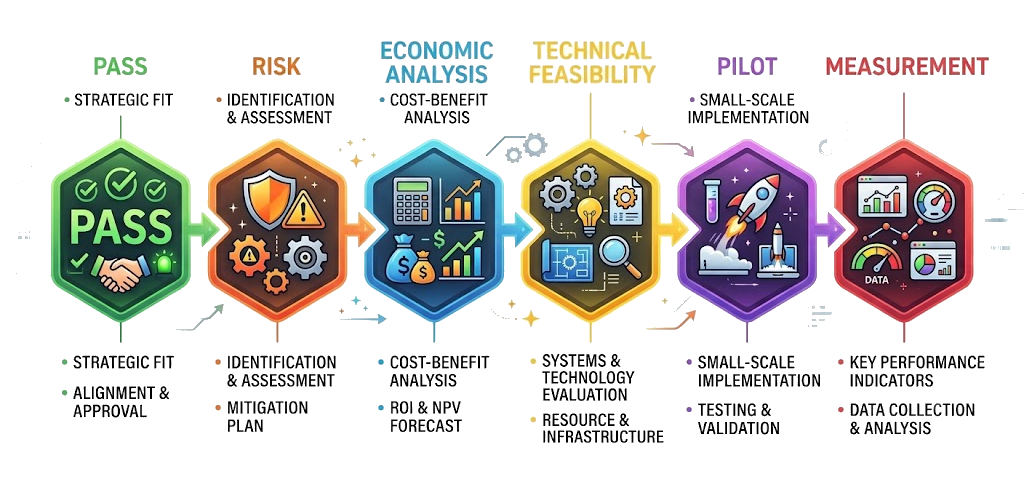
PASS → Risk → Economic Analysis → Technical Feasibility → Pilot → MeasurementThe objective is not to replace human legal judgment. It is to identify where technology can handle repetitive or information-intensive work while allowing legal professionals to focus on judgment, strategy, and client service.
1. Why a Workflow Scoring Methodology Is Essential
The standard approach to identifying AI opportunities in legal organizations often starts with a simple question:
“What takes our team the most time?”
Time is important, but it is not sufficient.
Consider a partner spending four hours on a highly specialized regulatory task twice a year. Compare that with a paralegal performing a 15-minute document-indexing task hundreds of times per month.
The first workflow consumes substantially more time per occurrence, but the second may represent a much larger cumulative opportunity because of its frequency.
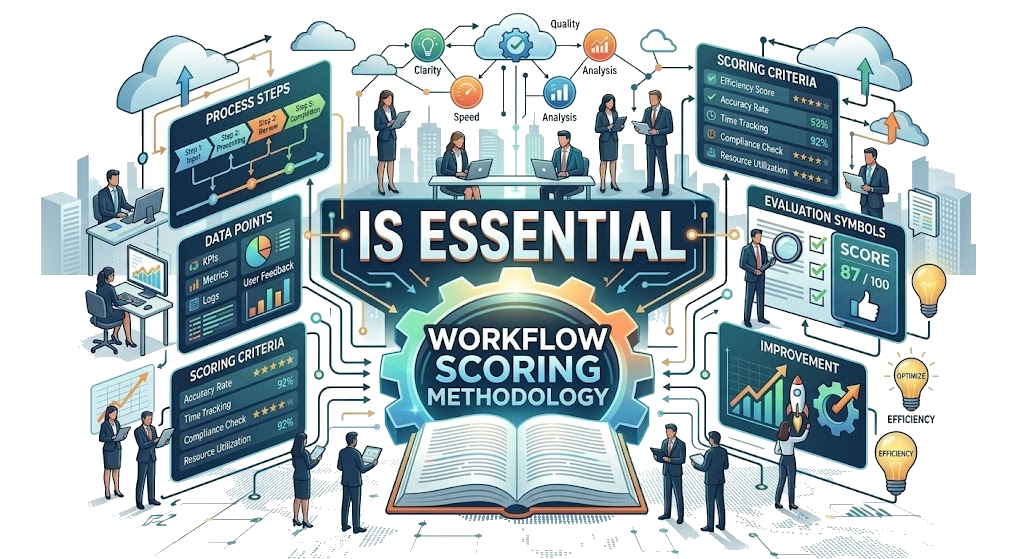
A workflow can also be highly repetitive yet remain a poor AI candidate if the underlying process is unpredictable or difficult to standardize.
Conversely, modern AI can assist with variable, unstructured information that previously resisted conventional rules-based automation.
A useful methodology therefore needs to consider multiple operational characteristics simultaneously.
PASS provides a common structure for making that comparison.

2. The Six Dimensions of PASS
PASS evaluates a workflow across six core dimensions:
| Dimension | Operational Focus | Primary Question |
|---|---|---|
| Time Intensity | Resource Consumption | How much professional time does one occurrence consume? |
| Manual Effort | Process Maturity | How much of the workflow currently relies on manual execution? |
| Frequency | Cumulative Volume | How often does the workflow occur? |
| Standardization | Process Predictability | How consistently can the workflow be performed across matters? |
| AI/Automation Fit | Technical Suitability | How well does the workflow align with available AI and automation capabilities? |
| Business Impact | Strategic Value | What tangible value could be created by improving the workflow? |
A score of 1 represents a relatively low-opportunity characteristic, while 5 represents a relatively high-opportunity characteristic.
The six scores are then combined to produce a PASS score from 6 to 30.
3. Dimension Breakdown and Scoring Standards
Dimension 1: Time Intensity
Question: How much professional time does one occurrence of the workflow consume?
Time should be measured using operational data whenever possible, such as time-tracking records, workflow measurements, or representative observations.
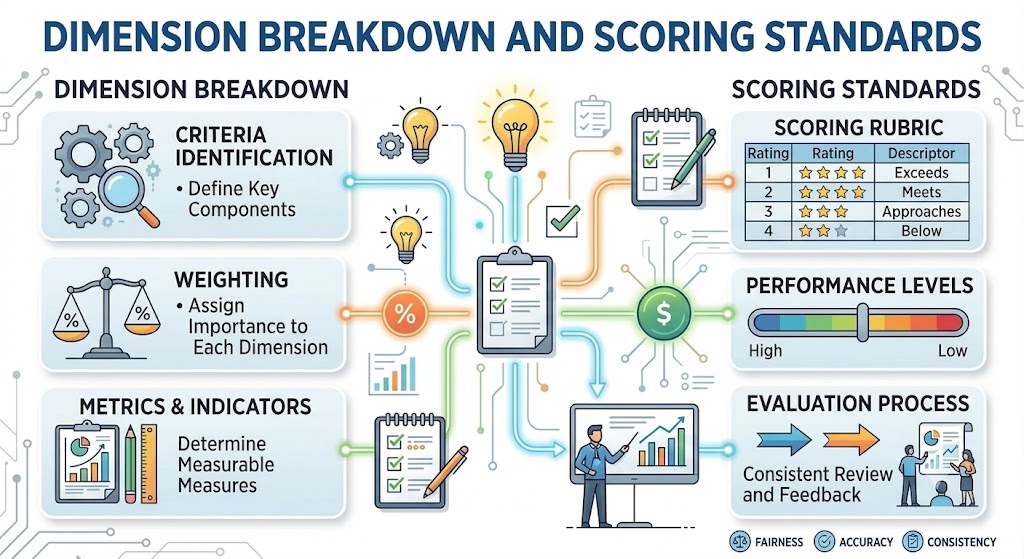
An illustrative five-point scale is:
| Score | Descriptive Metric | Illustrative Benchmark |
|---|---|---|
| 1 | Minimal | Less than 15 minutes |
| 2 | Low | 15–30 minutes |
| 3 | Moderate | 30–90 minutes |
| 4 | High | 1.5–4 hours |
| 5 | Significant | More than 4 hours |
The purpose of this dimension is to measure the resource intensity of a single occurrence, while Frequency measures cumulative workload.
Dimension 2: Manual Effort
Question: How much of the workflow currently requires human execution?
| Score | Descriptive Metric | Illustrative Benchmark |
|---|---|---|
| 1 | Minimal | Less than 15 minutes |
| 2 | Low | 15–30 minutes |
| 3 | Moderate | 30–90 minutes |
| 4 | High | 1.5–4 hours |
| 5 | Significant | More than 4 hours |
A short task can be completely manual and occur thousands of times. A longer task may already have significant automation.
Dimension 3: Frequency
Question: How often does the workflow occur?
Frequency captures the cumulative operational volume of the workflow.
An illustrative scale based on annual occurrences is:
| Score | Annual Occurrences |
|---|---|
| 1 | Fewer than 12 |
| 2 | 12–50 |
| 3 | 51–250 |
| 4 | 251–1,000 |
| 5 | More than 1,000 |
Organizations should establish their own frequency bands based on the distribution of workflows within their environment.
Dimension 4: Standardization
Question: How consistently can the workflow be performed across matters?
Standardization does not mean that every input or output must be identical.
Modern AI can operate effectively on unstructured information. Therefore, this dimension considers whether the underlying objective, evaluation criteria, process structure, and expected output are sufficiently repeatable.
| Score | Process Nature | Characteristics |
|---|---|---|
| 1 | Highly Variable | Unique objectives, unpredictable inputs, highly subjective outcomes |
| 2 | Mostly Variable | Significant matter-specific variation |
| 3 | Partially Standardized | Shared framework with meaningful variation by matter |
| 4 | Highly Standardized | Consistent process, recognizable inputs, defined evaluation criteria |
| 5 | Highly Repeatable | Strongly repeatable process with standardized inputs, criteria, and outputs |
Dimension 5: AI/Automation Fit
Question: How well does the workflow align with currently available AI and automation capabilities?
This dimension considers not only whether AI can technically perform part of the task, but also whether available technology is reasonably suited to the workflow’s inputs, outputs, data, and process characteristics.
Relevant technologies may include:
- Generative AI
- Large Language Models
- Natural Language Processing
- Machine Learning
- Document Intelligence
- Rules-based workflow automation
- Robotic Process Automation

An illustrative scale is:
| Score | Technical Suitability | Example Task Characteristics |
|---|---|---|
| 1 | Poor Fit | Requires physical presence, courtroom advocacy, or highly personal negotiation/td> |
| 2 | Limited Fit | Primarily dependent on unpredictable judgment with little structured information |
| 3 | Moderate Fit | Suitable for targeted drafting, extraction, classification, or workflow assistance |
| 4 | High Fit | Document classification, entity extraction, comparison, structured review |
| 5 | Excellent Fit | Transcript analysis, large-scale document analysis, research synthesis, structured document review |
It means that available technology appears capable of providing meaningful assistance or automation.
Dimension 6: Business Impact
Question: What value could the organization create by improving the workflow?
Business impact should consider more than labor savings.
Relevant outcomes may include:
- attorney productivity
- staff productivity
- turnaround time
- client service
- operating cost
- revenue capacity
- quality
- consistency
- risk reduction
- scalability
- competitive differentiation

An illustrative scale is:
| Score | Strategic Impact | Potential Outcome |
|---|---|---|
| 1 | Minimal | Negligible effect on cost, speed, or quality |
| 2 | Limited | Minor internal efficiency improvement |
| 3 | Moderate | Noticeable improvement in productivity or turnaround time |
| 4 | High | Material effect on client service, capacity, margin, or risk |
| 5 | Transformational | Significant new capacity, major competitive advantage, or substantial strategic value |
4. Calculating and Interpreting PASS
The baseline PASS formula is:
PASS = Time Intensity + Manual Effort + Frequency + Standardization + AI/Automation Fit + Business Impact
Because each dimension has a maximum score of 5:
Minimum score = 6
Maximum score = 30
The baseline interpretation is:
| PASS Score | Opportunity Tier | Recommended Action |
|---|---|---|
| 24–30 | Very High | Immediate priority for detailed evaluation or pilot |
| 18–23 | High | Strong candidate for solution architecture and evaluation |
| 12–17 | Moderate | Selective evaluation where implementation cost is low |
| 6–11 | Low | Generally deprioritize |
Why Are the Six Dimensions Equally Weighted?
The baseline PASS model uses equal weighting.
This is intentional.
The framework is designed to provide a general-purpose starting point without assuming, before collecting organizational data, that time, frequency, technical feasibility, or business impact should automatically dominate the assessment.
Equal weighting also makes the methodology easier to explain and apply consistently.
Organizations with sufficient historical data can later test alternative weighting schemes and compare those models against actual implementation outcomes.
This creates a path for PASS to evolve from an initial structured framework toward an organization-specific, empirically calibrated model.

5. Methodological Considerations and Limitations
PASS is a proposed decision-support framework, not a statistically validated prediction model.
The six dimensions provide a structured basis for comparing workflows, but the scoring thresholds and opportunity tiers should be calibrated to the organization’s:
- practice areas
- staffing model
- workflow volume
- technology maturity
- matter complexity
- operational data
The baseline model also does not assume that a high score will necessarily produce a specific financial return.
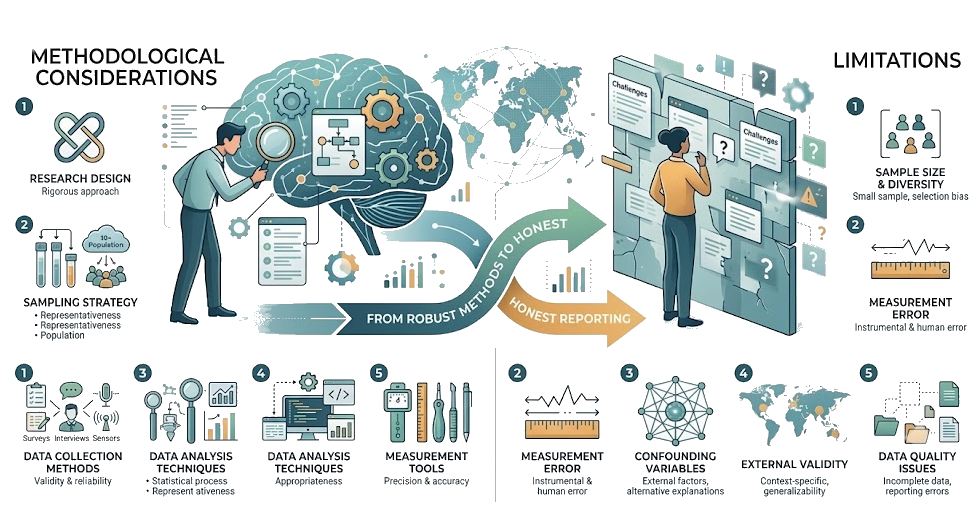
A workflow may score highly because it is time-consuming, frequent, standardized, and technically suitable for AI, yet implementation may still be constrained by data quality, integration complexity, governance requirements, adoption, or verification costs.
For this reason, PASS should be used as the first stage of an investment assessment.
The complete decision process should progress from:
PASS → Risk → Economic Analysis → Technical Feasibility → Pilot → Measurement
Organizations should periodically compare predicted opportunity with actual outcomes and recalibrate the methodology as evidence accumulates.
The intended improvement cycle is:
Score → Implement → Measure → Compare → Calibrate → Re-score
6. Applied Case Study: Deposition Transcript Analysis
The following case study is illustrative and demonstrates how the PASS methodology can be applied. The underlying operational measurements are hypothetical.
Consider a litigation department evaluating the analysis of a 300-page deposition transcript.
For purposes of this example, assume that:
- analysis requires approximately 3–5 hours of professional time;
- the workflow occurs regularly across active litigation matters;
- the analytical process follows a recognizable structure;
- the team identifies chronologies, admissions, contradictions, and important testimony;
- AI can assist with summarization, extraction, classification, and cross-referencing; and
- faster transcript analysis has meaningful value to litigation preparation.

The resulting assessment could be:
| Dimension | Score | Reasoning |
|---|---|---|
| Time Intensity | 4 | Several hours of professional time are required per transcript |
| Manual Effort | 5 | The baseline process is predominantly manual |
| Frequency | 4 | The workflow occurs repeatedly across active litigation |
| Standardization | 4 | The analytical objectives and evaluation criteria are reasonably consistent |
| AI/Automation Fit | 5 | AI can assist with large-scale text analysis, extraction, summarization, and comparison |
| Business Impact | 4 | AFaster analysis can improve case preparation and professional capacity |
| Total | 26 / 30 | Very High Opportunity |
Dimensional Reasoning
Time Intensity — 4/5
For this example, reviewing and extracting information from a 300-page transcript is assumed to require several hours of professional time.
Manual Effort — 5/5
The baseline workflow is assumed to rely primarily on manual reading, highlighting, note-taking, and summary preparation.
Frequency — 4/5
The workflow is assumed to occur regularly across active litigation matters.
Standardization — 4/5
Although the testimony itself varies, the analytical objectives are consistent: identify important testimony, construct chronologies, identify admissions and contradictions, and connect testimony to case issues.
AI/Automation Fit — 5/5
Modern AI systems can process substantial volumes of text and assist with summarization, entity extraction, issue identification, cross-referencing, and preliminary analysis.

Business Impact — 4/5
Reducing the time required to analyze transcripts can accelerate case preparation, increase professional capacity, and potentially reduce client costs.
The resulting 26/30 score places the workflow in the Very High Opportunity tier.
However, the score does not imply that the entire workflow should be automated.
Legal interpretation, strategic assessment, and final validation remain human responsibilities.
An appropriate implementation may therefore be:
AI analysis → Structured results → Professional validation → Final work product
This illustrates an important principle:
A high PASS score identifies a workflow worth investigating; it does not prescribe the technology or eliminate human judgment.

7. Decoupling Risk from Opportunity
One of the most important principles of PASS is that risk should not simply reduce the opportunity score.
A high-risk workflow can still represent an enormous technology opportunity.
If risk were subtracted from the opportunity score, organizations could incorrectly conclude that high-risk workflows are low-value opportunities.
Instead:
Opportunity determines priority. Risk determines governance.
Every workflow should therefore receive a separate Risk Rating.

| Dimension | Score |
|---|---|
| Risk Level | Description |
| Low | Errors have limited consequences and are readily detected |
| Medium | Errors can affect operational throughput or draft work product but are normally caught through review |
| High | Errors could materially affect legal work, litigation strategy, deadlines, financial obligations, or client outcomes |
| Critical | Errors could create significant legal liability, ethical issues, regulatory violations, or serious client harm |
The resulting decision matrix is:
| Low/Medium Risk | High/Critical Risk | |
|---|---|---|
| High PASS | Prioritize for AI or automation | AI assistance with mandatory human validation |
| Moderate PASS | Selective evaluation | Generally defer unless a compelling case exists |
| Low PASS | Deprioritize | Do not prioritize |
8. Financial Valuation: From PASS to Economic Opportunity and ROI
PASS identifies workflows worth investigating. Financial analysis determines whether the opportunity justifies investment.
8.1 Annual Workload
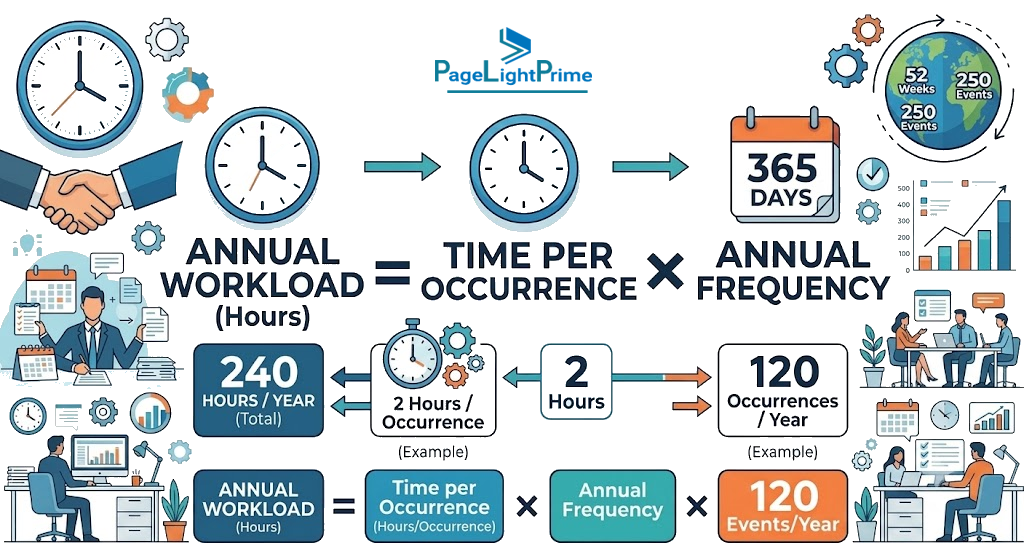
The first calculation estimates the total annual workload:
Annual Workload (Hours) = Time per Occurrence × Annual Frequency
For example, a workflow requiring two hours per occurrence and occurring 1,000 times per year represents:
2 × 1,000 = 2,000 annual hours
8.2 Gross Economic Opportunity
The next step estimates the economic value of the workload:
Gross Economic Opportunity = Annual Workload × Loaded Labor Cost
If the loaded labor cost is $75 per hour:
2,000 × $75 = $150,000
This should not be described as guaranteed savings.
It represents the gross addressable economic opportunity before implementation costs, human review, adoption, and other constraints.

8.3 Expected Realized Benefit
The organization should then estimate what percentage of the gross opportunity can realistically be captured.
- percentage of the workflow actually automated;
- residual human-review time;
- adoption;
- exception rates; and
- quality-control requirements.
For example:
Expected Realized Benefit = Gross Economic Opportunity × Expected Realization Rate

8.4 Implementation Cost
Implementation costs may include:
- software licensing
- development
- configuration
- integration
- data preparation
- testing
- training
- governance
- ongoing maintenance

8.5 ROI
Once realized benefit and implementation cost are known:
ROI = (Realized Benefit − Implementation Cost) ÷ Implementation Cost
This distinction is important because PASS is not an ROI score.
PASS answers:
Is this workflow worth investigating?
The financial model answers:
Is the proposed solution economically worthwhile?

9. Measuring Actual Results
A methodology should not stop at prioritization.
After implementing AI or automation, organizations should measure actual results against the baseline.
Recommended metrics include:
- baseline completion time
- post-implementation completion time
- human-review time
- percentage of workflow automated
- error rate
- exception rate
- turnaround time
- adoption
- user satisfaction
- client impact
- realized financial benefit

A simple efficiency measure is:
Time Reduction % = (Baseline Time − Post-Implementation Time) ÷ Baseline Time × 100
For example, if a workflow originally required 120 minutes and subsequently requires 60 minutes:
Time Reduction = (120 − 60) ÷ 120 × 100 = 50%
Actual results should then be compared with the original PASS assessment.
This creates a feedback loop:
Assess → Prioritize → Implement → Measure → Reassess

10. Seven-Step PASS Implementation Lifecycle
Organizations can operationalize the methodology through seven steps.
1. Workflow Inventory
Identify significant workflows performed by attorneys, paralegals, legal operations personnel, and administrative teams.
2. Baseline Metric Collection
Gather operational data such as:
- average completion time
- annual volume
- loaded labor cost
- number of matters
- turnaround time
- current automation level
3. Dimensional Scoring
Assign 1–5 ratings across all six PASS dimensions using defined criteria.

4. PASS Calculation
Sum the six scores to produce the 6–30 PASS score.
5. Risk Layer Assignment
Assign a separate Low, Medium, High, or Critical Risk Rating.
6. Controlled Pilot
Test selected AI or automation solutions on high-opportunity workflows while measuring actual performance.
7. Iterative Re-evaluation
Compare actual results with the original assessment, refine scoring thresholds where appropriate, and expand successful implementations.

11. PASS Is a Prioritization Framework, Not an Automation Mandate
A high PASS score should trigger further evaluation, not automatic deployment.
Three additional questions should be answered before implementation:
1. Is the opportunity economically meaningful?
A high score does not necessarily mean the financial benefit will justify implementation costs.
2. Can the risk be appropriately controlled?
High-risk workflows may require mandatory professional review, auditability, access controls, and other governance mechanisms.
3. Can the workflow be implemented reliably?
The organization must consider data quality, integrations, security, system capabilities, adoption, and operational complexity.
Only after these questions are addressed should the organization proceed to implementation.
The complete decision sequence is therefore:
PASS → Risk → Economic Analysis → Technical Feasibility → Pilot → Measurement

12. What PASS Does—and Does Not—Measure
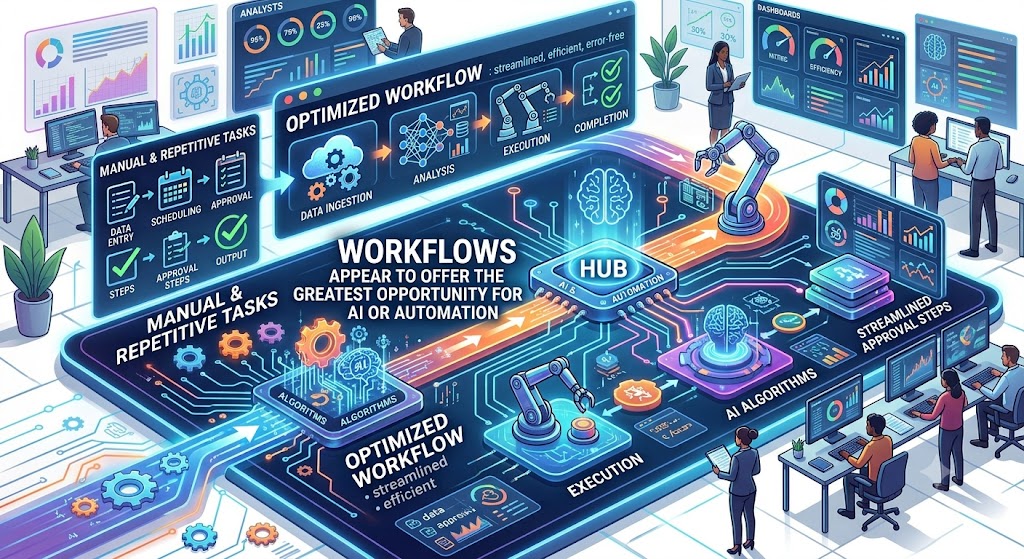
PASS is designed to answer:
Which workflows appear to offer the greatest opportunity for AI or automation?
It is not designed to determine:
- whether AI will replace a particular job;
- whether an AI system will be sufficiently accurate for production;
- whether a particular technology vendor is appropriate;
- whether a workflow is legally or ethically permissible to automate;
- the precise ROI of an implementation; or
- whether human review can safely be eliminated.
Those questions require additional technical, financial, legal, ethical, security, and governance analysis.
PASS should therefore be viewed as the front end of an AI investment decision, rather than the entire decision-making process.
13. Why PASS Is Useful for Legal Organizations
Legal work is unusually heterogeneous.
Some activities are highly repetitive and structured. Others depend heavily on professional judgment, contextual interpretation, experience, negotiation, and strategy.
A useful AI strategy must recognize that difference.
PASS provides a common language for attorneys, legal operations teams, technology leaders, and firm management to evaluate potential AI opportunities based on the characteristics of the work itself.
Instead of asking:
“Where can we use AI?”
an organization can ask:
“Which workflows consume meaningful resources, occur frequently enough to matter, have sufficient process consistency, create meaningful business value, and are technically suitable for AI or automation?”
That is a much more actionable question.

14. Strategic Summary
AI adoption in legal organizations should not begin with technology.
It should begin with the workflow.
The PageLightPrime AI Scoring System (PASS) provides a structured framework for identifying where AI and automation may create meaningful value.
By evaluating:
- Time Intensity
- Manual Effort
- Frequency
- Standardization
- AI/Automation Fit
- Business Impact

organizations can move beyond intuition and establish a repeatable process for identifying and prioritizing opportunities.
The separate risk layer ensures that a high-value workflow is not automatically treated as a candidate for unrestricted automation.
The ultimate objective is not to maximize the amount of legal work performed by AI.
It is to determine:
Which work should be performed by people, which work should be performed by technology, and where the combination of human judgment and AI assistance creates the greatest value.
PASS provides a framework for making that decision systematically.

“
About PageLightPrime
The PageLightPrime AI Scoring System (PASS) provides a strategic approach for prioritizing legal technology investments.
PageLightPrime provides the execution environment to operationalize those priorities.
Built for law firms and enterprise legal departments, PageLightPrime combines legal practice management , law firm document management, workflow automation, document intelligence, and Microsoft 365 integration.
By integrating AI-assisted capabilities into existing legal workflows and maintaining appropriate human oversight, organizations can move from identifying high-opportunity workflows to implementing them in a controlled and measurable manner.

“
FAQ: Frequently Asked Questions About Sage Timeslips Alternatives
What does PASS measure?
PASS evaluates six dimensions:
- Time Intensity
- Manual Effort
- Frequency
- Standardization
- AI/Automation Fit
- Business Impact
Each dimension receives a score from 1 to 5.
What is the maximum PASS score?
The maximum PASS score is 30, calculated by giving a workflow a score of 5 across all six dimensions.
The minimum score is 6.
What does a high PASS score mean?
A high PASS score means that a workflow has characteristics that make it worthy of further evaluation for AI or automation.
A score of 24–30 represents the Very High Opportunity tier.
It does not guarantee a particular level of cost savings, ROI, accuracy, or implementation success.
Does a high PASS score mean the workflow should be fully automated?
No.
PASS identifies opportunity, not the appropriate level of automation.
A high-scoring workflow may be best implemented as:
AI assistance → Human validation → Final work product
rather than complete automation.
Does PASS measure risk?
No.
PASS intentionally separates opportunity from risk.
The PASS score determines how attractive a workflow may be as an AI or automation opportunity. A separate risk assessment determines the level of governance and human oversight required
Why isn't risk included in the PASS score?
A high-risk workflow can still represent a significant technology opportunity.
Reducing its opportunity score simply because it is high-risk could cause organizations to overlook valuable workflows.
PASS therefore follows the principle:
Opportunity determines priority. Risk determines governance.
How is the PASS score calculated?
The baseline formula is:
PASS = Time Intensity + Manual Effort + Frequency + Standardization + AI/Automation Fit + Business Impact
Each dimension is scored from 1 to 5.
Are the PASS scoring thresholds universal?
No.
The thresholds presented in the methodology are intended as an initial framework.
Organizations should calibrate thresholds based on their own workflow volumes, practice areas, staffing models, technology environment, and operational data.
Is PASS an ROI calculator?
No.
PASS identifies workflows that may deserve further investigation.
After a workflow receives a high PASS score, the organization should conduct a separate economic analysis that considers:
- annual workload
- loaded labor cost
- expected efficiency improvement
- human-review requirements
- implementation costs
- ongoing operating costs
- realized benefit
ROI should be calculated only after these factors are considered.
Can PASS be used for workflows that are not suitable for generative AI?
Yes.
PASS evaluates AI and automation opportunities, not generative AI alone.
Some workflows may be better suited to:
- rules-based automation
- workflow automation
- document intelligence
- traditional software
- AI-assisted processing
- a combination of technologies
Can PASS be used by corporate legal departments?
Yes.
The framework can be applied to legal workflows in both law firms and corporate legal departments.
The scoring thresholds can be adapted to the organization's operating model.
Can PASS be used outside the legal industry?
The underlying scoring principles may be applicable to other professional-service workflows, but PASS is specifically designed and positioned around legal workflows and legal technology.
How should a law firm start using PASS?
A practical starting point is to:
- Inventory significant legal workflows.
- Establish baseline time and volume.
- Score each workflow across the six PASS dimensions.
- Calculate the PASS score.
- Apply a separate risk assessment.
- Conduct an economic and technical feasibility assessment.
- Pilot the highest-priority workflows.
- Measure actual results and recalibrate the methodology.
Does PASS replace professional judgment?
No.
PASS is a decision-support framework. It does not determine whether a particular legal workflow can safely be automated or whether an AI-generated result is legally sufficient.
Professional judgment, appropriate review, and organizational governance remain essential.
What is the goal of PASS?
The goal is not to maximize the amount of legal work performed by AI.
The goal is to help organizations determine:
Which work should be performed by people, which work can be supported by technology, and where the combination of human judgment and AI creates the greatest value.