
Law Firm Billing Software 2026: Best Legal Billing and Invoicing Solutions for Modern Law Firms
Modern law firm billing software combines legal time tracking, matter-based billing, trust accounting, LEDES electronic billing, invoice automation, and financial reporting into a single platform. Firms using Microsoft 365 for law firms increasingly prefer solutions that integrate billing with document management, Outlook, SharePoint, and collaboration tools.
Law firm billing is no longer just about creating invoices.
Modern law firms must manage complex billing requirements, including multiple attorneys, different billing rates, client-specific guidelines, trust funds, electronic billing standards, expenses, collections, and financial reporting.
Written by Knowledge Team, posted on July 06, 2026

Traditional accounting systems and generic invoicing applications were not designed for the way law firms operate.
A modern law firm billing software solution should help firms:
- Capture more billable time
- Reduce billing errors
- Automate invoice generation
- Improve collections
- Maintain trust accounting compliance
- Support corporate client billing requirements
- Provide real-time financial visibility
In 2026, leading legal billing platforms are evolving from simple invoicing tools into complete legal financial management solutions that connect matters, time, expenses, invoices, payments, and compliance workflows.
This guide explains what law firms should look for when selecting billing software, compares leading approaches, and explains how modern platforms help firms improve revenue management.

Key Takeaways

Law Firm Billing Challenges in 2026: Industry Statistics
Modern law firms face increasing pressure to improve billing efficiency, accelerate cash flow, and ensure compliance with corporate billing requirements. Industry research highlights key operational challenges:
Delayed time entry continues to reduce billable revenue
Studies show that delayed time entry remains one of the leading causes of lost billable hours, as attorneys frequently record time after work is completed, resulting in forgotten or underreported entries.
Electronic billing adoption continues to grow
Corporate legal departments increasingly require LEDES electronic billing and strict billing guideline compliance, driving higher adoption of structured e-billing systems across law firms.
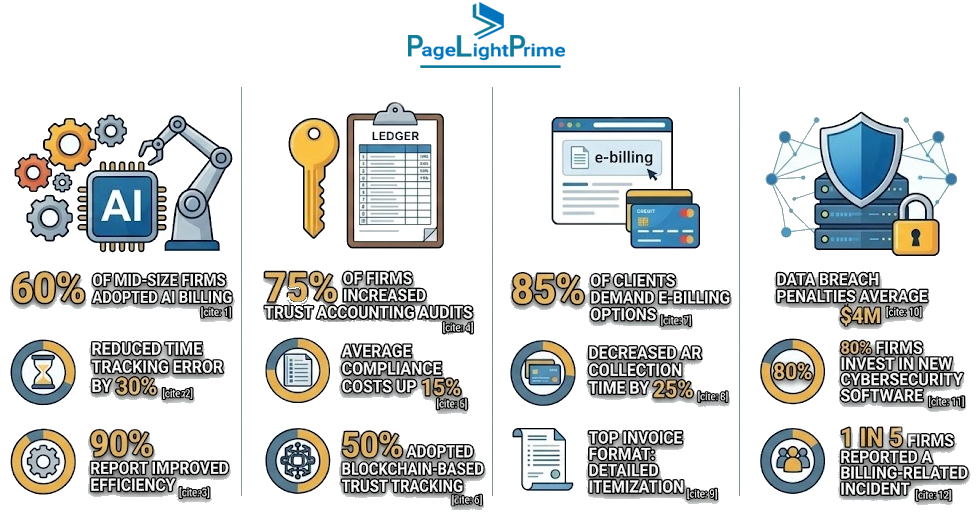
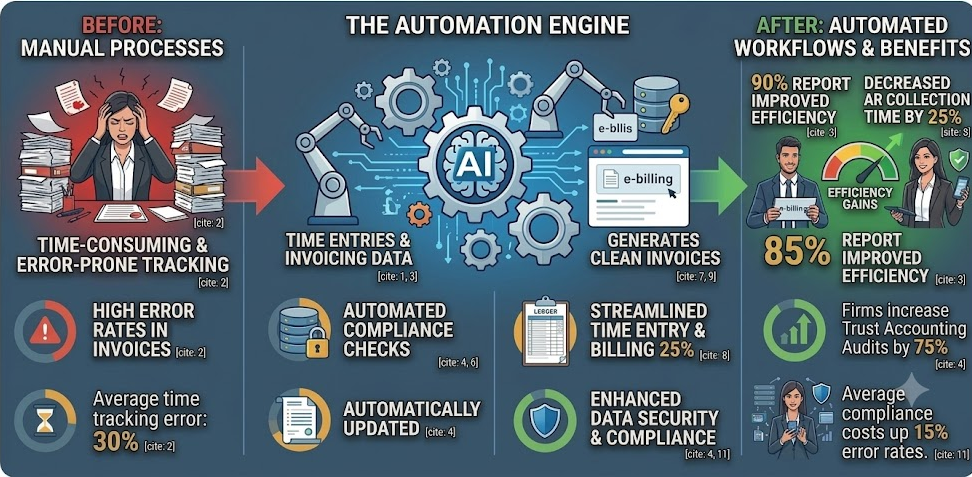
Automated billing workflows improve efficiency
Firms using automated invoice generation, approval workflows, and billing validation reduce administrative overhead and shorten billing cycles.
Microsoft 365 remains a dominant productivity platform
Microsoft 365 continues to be widely adopted across professional services firms, making native integration with Outlook, Word, Teams, and SharePoint Legal DMS a key advantage for legal billing platforms.
Hourly billing still dominates legal services
Despite alternative fee arrangements, hourly billing remains the most widely used legal billing model, reinforcing the importance of accurate time tracking and billing systems.
What Is Law Firm Billing Software?
Law firm billing software is a specialized solution designed to manage the complete legal billing lifecycle.
Unlike general accounting software, legal billing platforms understand that law firm revenue is connected to matters, attorneys, clients, and legal workflows.
A complete legal billing system should support:
- Matter-based billing
- Attorney time tracking
- Expense management
- Multiple billing rates
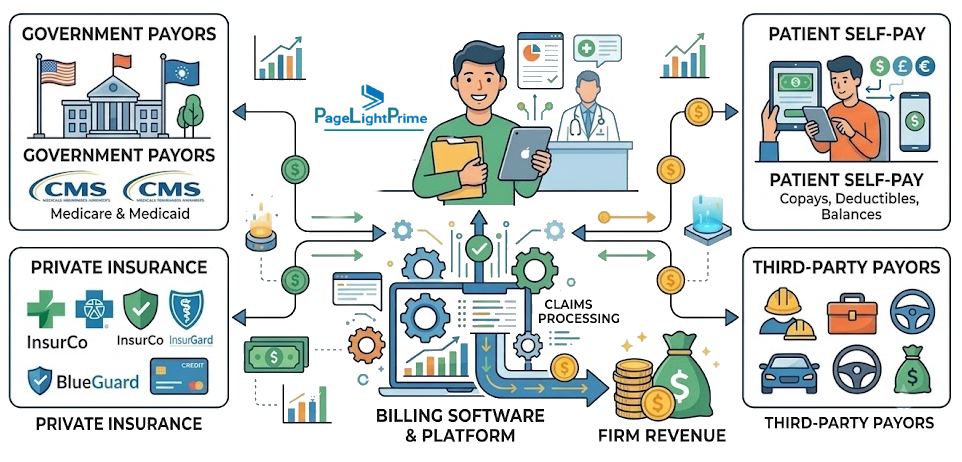
- Multiple payors
- Retainer management
- Trust accounting
- LEDES electronic billing
- UTBMS codes
- Invoice approval workflows
- Accounts receivable reporting
The purpose is not just to create invoices, but to improve revenue capture, billing accuracy, and financial performance.

Why Law Firms Need Dedicated Billing Software
Reduce Lost Billable Time
Attorneys often fail to capture all billable activities such as emails, research, drafting, and client communication. Modern systems reduce lost revenue through automated and integrated time tracking.
Improve Billing Accuracy
Billing errors occur due to incorrect rates, missing expenses, or misallocated matters. Legal billing software connects attorneys, matters, rates, and billing rules before invoices are generated.
Accelerate Collections
Firms gain visibility into accounts receivable, aging reports, payment history, and collection trends to improve cash flow.

Essential Features of Law Firm Billing Software
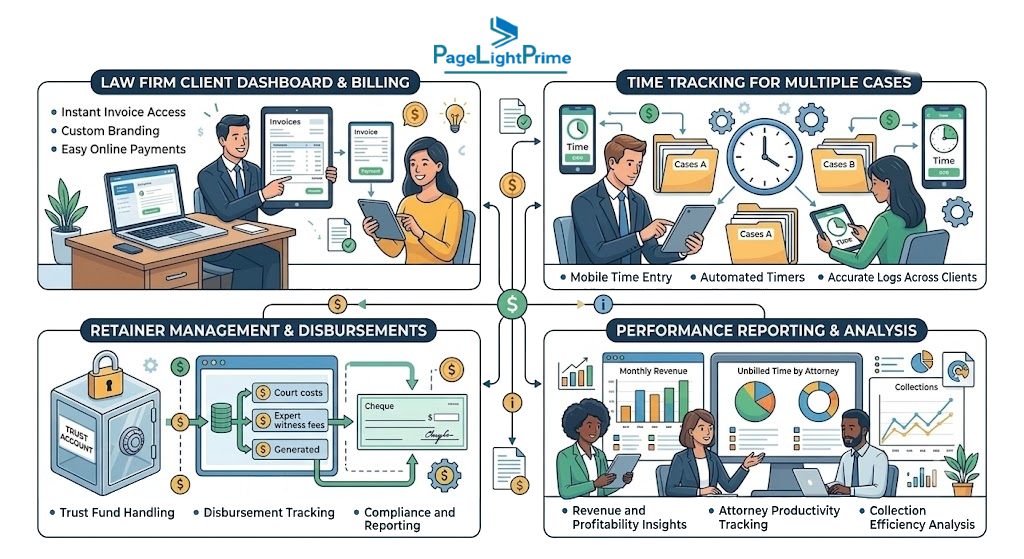
1. Legal Time Tracking
Supports timers, mobile entry, Outlook integration, and matter-based tracking.
2. Invoice Automation
Automates invoice generation, templates, approvals, batch billing, and electronic delivery.
3. Multiple Billing Rates
Supports partner, associate, paralegal, client-specific, and matter-specific rates.
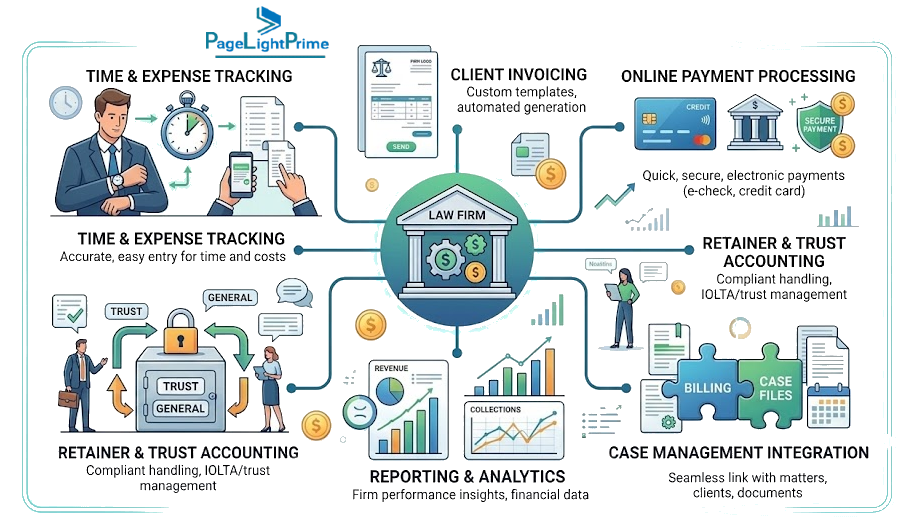
4. Multi-Payor Billing
Allocates billing across multiple responsible parties such as insurers or corporations.
5. LEDES Electronic Billing
Supports LEDES 1998B, XML formats, UTBMS codes, and billing guideline validation.
6. Trust Accounting Integration
Includes client trust accounts, retainers, withdrawals, ledgers, and reconciliation workflows.
Real-World Examples of Legal Billing Software in Action
Litigation Firm (40 Attorneys)
Automatically generates monthly invoices, applies billing rules, produces LEDES files, routes approvals, and reconciles trust accounts without external systems.
Multi-Office Law Firm
Centralizes WIP tracking, AR monitoring, profitability reporting, and standardized billing across multiple offices.
Boutique Firm
Improves cash flow through automated time capture, invoicing, AR tracking, and reminders.
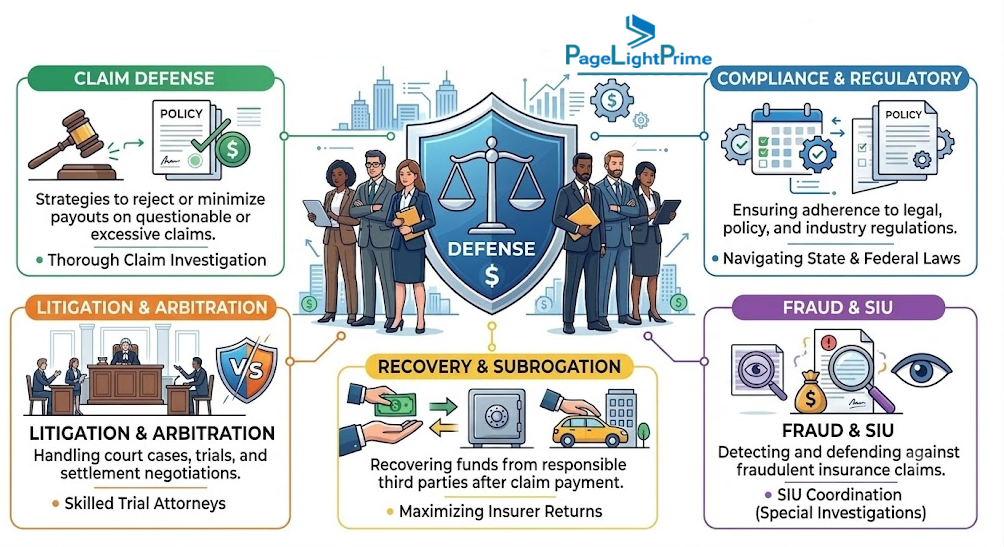
Insurance Defense Practice
Automates LEDES billing, applies UTBMS codes, and reduces invoice rejection rates.
Estate & Family Law Practice
Uses automated three-way trust reconciliation for compliance and audit readiness.
Microsoft 365-Native Firm
Manages billing, documents, and communication entirely within Outlook, Word, Teams, and SharePoint.
Who Should Use PageLightPrime Legal Billing Software?
PageLightPrime is well suited for:
- Mid-sized law firms
- Large law firms
- Corporate legal departments
- Firms already using Microsoft 365
- Firms requiring LEDES billing
- Firms managing client trust accounts
- Multi-office legal practices
- Firms seeking unified legal operations

Why Choose PageLightPrime?
PageLightPrime is a Microsoft 365-native legal billing and practice management platform designed to unify legal operations.
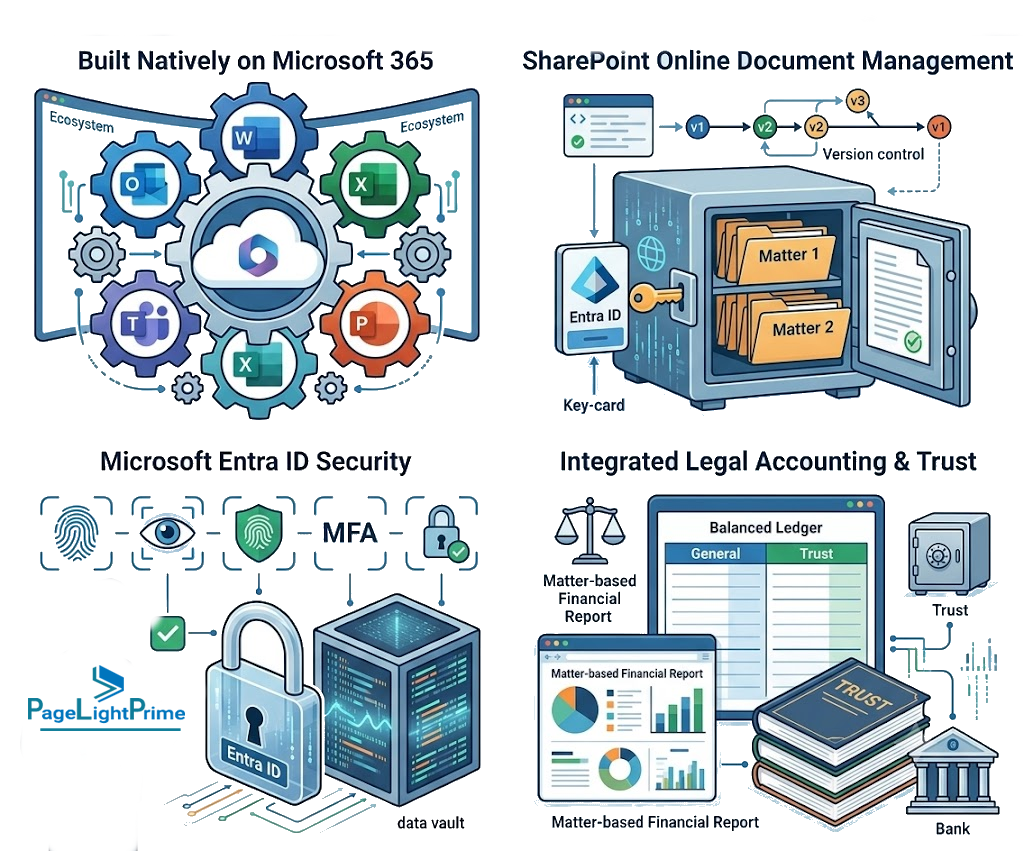
Built Natively on Microsoft 365
Operates directly within the Microsoft ecosystem.
SharePoint Online Document Management
Matter-based secure document storage with version control.
Microsoft Entra ID Security
Enterprise-grade authentication and access control.
Integrated Legal Accounting
Matter-based financial management and reporting.
Trust Accounting
Supports retainers, ledgers, reconciliation, and compliance.
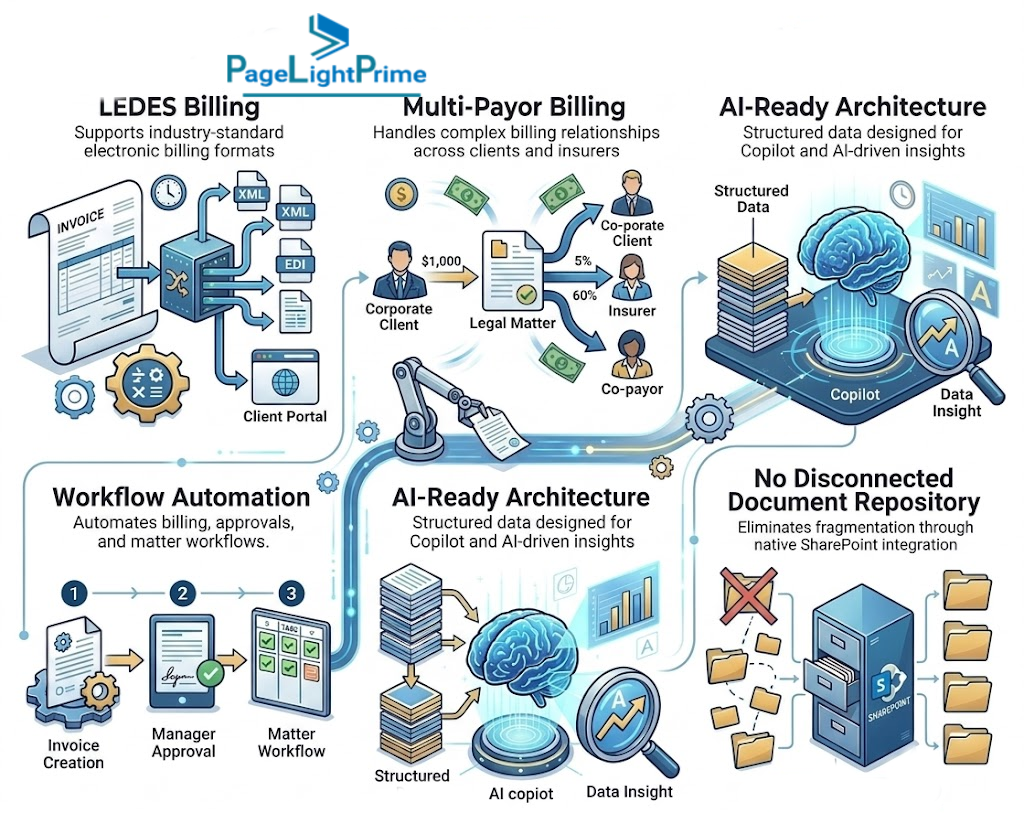
LEDES Billing
Supports industry-standard electronic billing formats.
Multi-Payor Billing
Handles complex billing relationships across clients and insurers.
Workflow Automation
Automates billing, approvals, and matter workflows.
AI-Ready Architecture
Structured data designed for Copilot and AI-driven insights.
No Disconnected Document Repository
Eliminates fragmentation through native SharePoint integration.
Law Firm Billing Software Comparison 2026
| Software | Best For | Deployment | Trust Accounting | LEDES Billing | Microsoft 365 Integration | Starting Firm Size | Notable Strengths | Considerations |
|---|---|---|---|---|---|---|---|---|
| PageLightPrime | Microsoft 365-based firms | Cloud (Native) | Yes | Yes | Native | Solo–Enterprise | Full legal financial platform | Best for Microsoft ecosystem firms |
| Clio Manage | General practice management | Cloud | Yes (varies) | Limited | Integration-based | Solo–Mid | Ease of use, ecosystem | External integrations needed |
| CosmoLex | Legal accounting focus | Cloud | Yes | Limited | Limited | olo–Mid | Accounting depth | Less workflow depth |
| MyCase | Small firms | Cloud | Yes | Limited | Limited | Solo–Small | Simplicity | Limited enterprise features |
| TimeSolv | Billing-focused firms | Cloud | Limited | Yes | Integration-based | Solo–Mid | Time tracking strength | Not full platform |
| QuickBooks Online | General accounting | Cloud | No legal trust model | No | Integration-based | All sizes | Accounting system | Not legal-specific |
Choosing the Right Billing Platform
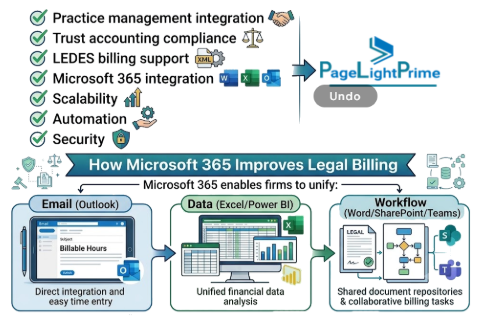
Firms should evaluate:
- Practice management integration
- Trust accounting compliance
- LEDES billing support
- Microsoft 365 integration
- Scalability
- Automation
- Security
How Microsoft 365 Improves Legal Billing
Microsoft 365 enables firms to unify:
- Email (Outlook)
- Documents (Word + SharePoint)
- Collaboration (Teams)
- Identity (Entra ID)
- AI (Copilot)
This reduces duplication and improves workflow efficiency.
Why PageLightPrime?
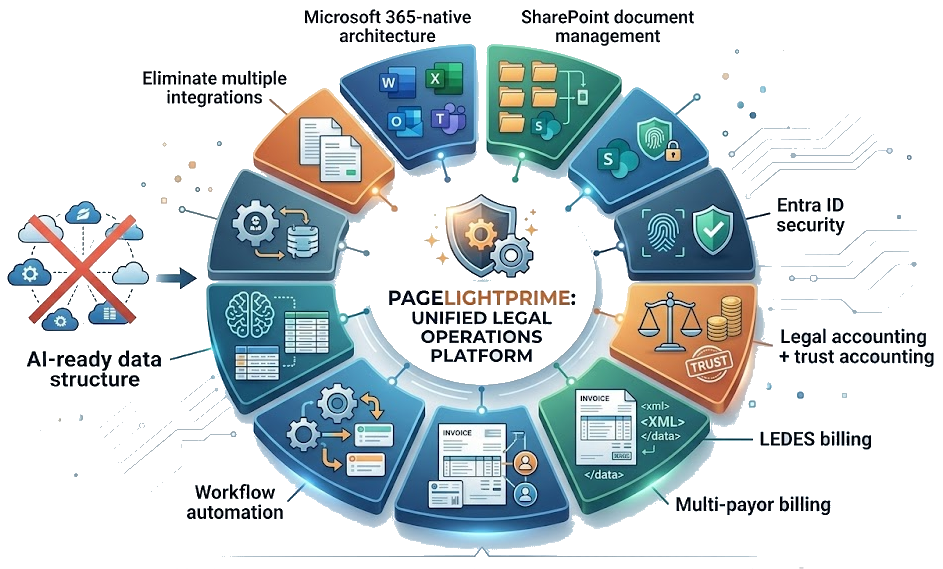
PageLightPrime stands out because it combines:
- Microsoft 365-native architecture
- SharePoint document management
- Entra ID security
- Legal accounting + trust accounting
- LEDES billing
- Multi-payor billing
- Workflow automation
- AI-ready data structure
- Unified legal operations platform
Unlike fragmented systems, it eliminates disconnected document repositories and multiple integrations.
“
Conclusion
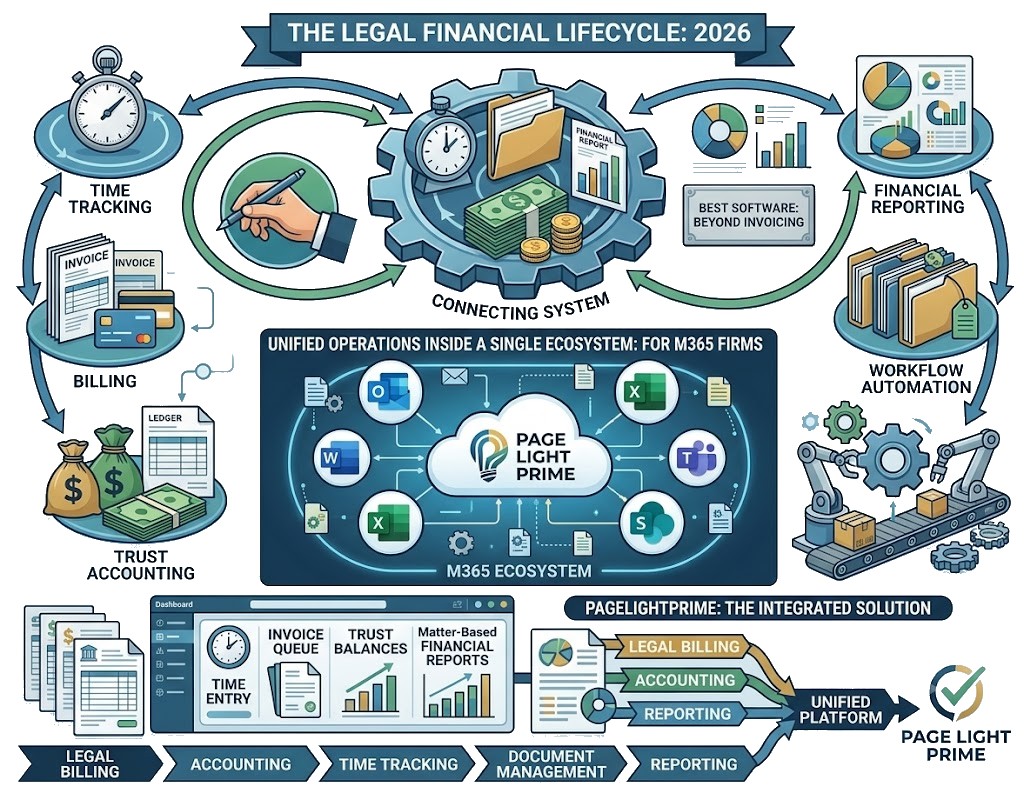
The best law firm billing software in 2026 is not just about invoicing—it is about connecting the entire legal financial lifecycle.
Modern firms need integrated systems that combine:
- Time tracking
- Billing
- Trust accounting
- Document management
- Workflow automation
- Financial reporting
For Microsoft 365-based firms, the future is unified legal operations inside a single ecosystem.
PageLightPrime delivers this unified approach by combining legal billing, accounting, trust accounting, matter management, and Microsoft 365 integration into one platform.
“
FAQ: Frequently Asked Questions About Sage Timeslips Alternatives
What are UTBMS codes?
Standard legal billing classification codes.
Can legal billing software integrate with Outlook?
Yes, many platforms integrate with Outlook for time capture and matter tracking.
Does legal billing software include trust accounting?
Yes, advanced systems include full trust accounting workflows.
Can small law firms benefit?
Yes, especially for automation and cash flow improvement.
What is matter-based billing?
Billing tied to individual legal matters.
What is three-way trust reconciliation?
Matching bank, client ledger, and trust ledger balances.
Can it replace QuickBooks?
In many cases, yes for legal-specific workflows.
What is legal accounting software?
Accounting designed specifically for law firm operations.
How does Microsoft 365 help?
It unifies communication, documents, identity, and billing workflows.
What reports should it provide?
WIP, AR aging, profitability, and trust reports.