
Best Clio Alternatives in 2026: 8 Legal Practice Management Solutions Compared
Looking for the best Clio alternative in 2026? Whether you’re frustrated by rising software costs, searching for built-in legal accounting, need deeper Microsoft 365 integration, want better document management, or are evaluating AI-powered legal software, there are several strong alternatives available today.
Clio remains one of the most recognized legal practice management platforms in the legal technology market. Thousands of law firms rely on it for matter management, calendaring, billing, client communication, and workflow management. For many firms, it remains a capable solution.
However, legal technology has evolved significantly.
Written by Knowledge Team, posted on June 18, 2026
Modern law firms expect much more than basic practice management. Firms increasingly require integrated legal accounting, trust accounting compliance, document management, CRM capabilities, AI-powered productivity tools, workflow automation, client portals, advanced reporting, and seamless Microsoft 365 integration.
As firms grow, managing multiple disconnected systems for accounting, document storage, email management, billing, and client communication can create inefficiencies and increase operational costs. Many firms are now evaluating whether a more unified platform can better support their long-term growth.
Artificial intelligence is also becoming a major factor in legal software evaluations. Law firms are increasingly seeking platforms that can assist with document generation, matter summaries, billing review, time capture, knowledge management, and workflow automation.
The good news is that today’s legal software market offers excellent alternatives to Clio. Some solutions focus on legal accounting, others excel in document management, while several are integrating AI directly into legal workflows.
In this guide, we’ll compare the best Clio alternatives in 2026, explain why firms switch from Clio, evaluate AI capabilities, review accounting and document management features, and help you identify the right platform for your firm.
Best Clio Alternatives at a Glance
| Requirement | Recommended Solution |
|---|---|
| Best Overall Clio Alternative | PageLightPrime |
| Best for Microsoft 365 Users | PageLightPrime |
| Best for Solo Attorneys | MyCase |
| Best for Small Firms | PracticePanther |
| Best for Legal Accounting | CosmoLex |
| Best for Mid-Sized Firms | Centerbase |
| Best for Legal Accounting | CosmoLex |
| Best for Personal Injury Firms | Filevine |
| Best for Litigation Firms | CosmoLex |
| Best for Document Automation | Smokeball |
| Best for Workflow Automation | PageLightPrime |
What Is the Best Clio Alternative?
The best Clio alternative depends on your firm’s size, practice area, accounting requirements, and technology preferences.
For firms seeking deeper Microsoft 365 integration, legal accounting, trust accounting, document management, CRM capabilities, AI-powered workflows, and LEDES billing, PageLightPrime is one of the strongest alternatives available.
For solo attorneys and smaller firms prioritizing ease of use, MyCase and PracticePanther remain popular choices.
For accounting-focused firms seeking an integrated financial platform, CosmoLex is frequently considered.
For personal injury and litigation practices, Filevine and Neos offer specialized workflows designed for high-volume case management.
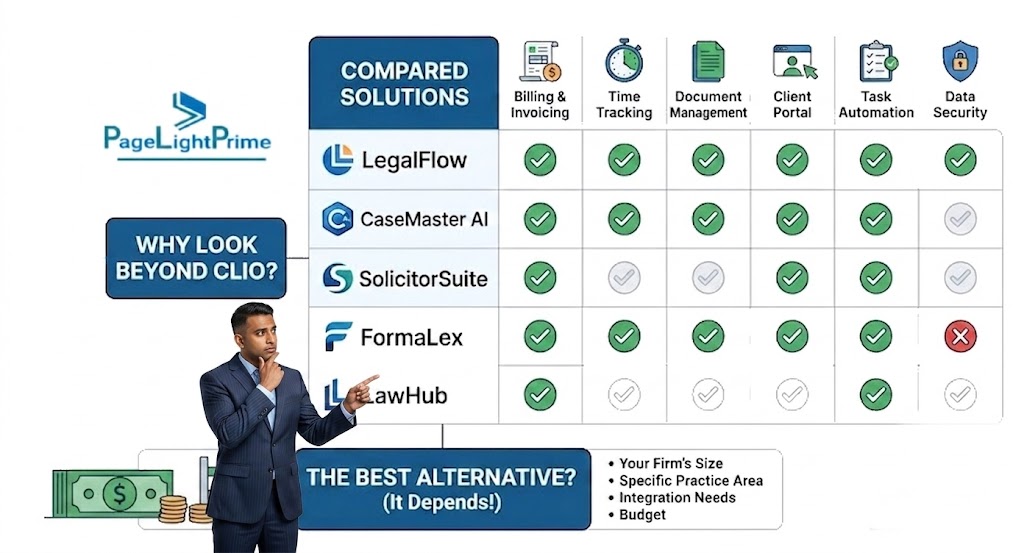
Clio vs PageLightPrime
Many law firms evaluating legal practice management software eventually narrow their search to Clio versus PageLightPrime. While both platforms support matter management, billing, calendaring, client communication, and legal workflows, they take fundamentally different approaches to legal operations, document management, accounting, and Microsoft 365 integration.
Clio is a cloud-based legal practice management platform widely used by solo attorneys, small firms, and growing practices. It provides a broad ecosystem of integrations and core legal practice management functionality.
PageLightPrime takes a more unified approach by combining legal practice management, legal accounting, trust accounting, law firm CRM, lawyer document management software, workflow automation, client portals, Microsoft 365 for law firm collaboration, and AI-powered productivity tools within a single platform.

Clio vs PageLightPrime Feature Comparison
| Capability | Clio | PageLightPrime |
|---|---|---|
| Practice Management | Yes | Yes |
| Legal Accounting | Add-on / Limited | Built-in |
| Trust Accounting | Yes | Yes |
| SharePoint Integration | No | Native |
| Microsoft 365 Integration | Moderate | Native |
| Outlook Integration | Moderate | Native |
| Teams Integration | Limited | Native |
| Document Management | Good | Advanced SharePoint-Based |
| CRM and Intake Management | Add-on | Built-in |
| Client Porta | Yes | Yes |
| LEDES Billing | Limited | Advanced |
| UTBMS Coding | Limited | Advanced |
| Workflow Automation | Good | Advanced |
| AI Workflow Automation | Emerging | Integrated |
| Reporting and Dashboards | Good | Advanced |
| Multi-Office Support | Good | Strong |
| Insurance Defense Workflows | Limited | Advanced |
When Clio May Be the Better Choice
Clio remains a strong option for solo attorneys, small firms, and practices seeking a well-established cloud-based legal practice management solution with a large integration marketplace. Firms that primarily need matter management, billing, calendaring, and client communication without extensive accounting or Microsoft 365 requirements may find Clio sufficient for their needs.
When PageLightPrime May Be the Better Choice
PageLightPrime is often evaluated by firms seeking a more comprehensive operational platform. Organizations requiring legal accounting, trust accounting, SharePoint-based document management, Microsoft 365 collaboration, CRM functionality, LEDES billing, insurance defense workflows, workflow automation, and AI-powered productivity tools may benefit from a unified platform approach that reduces reliance on multiple third-party systems.

Key Difference: Microsoft 365 and SharePoint
One of the largest distinctions between the two platforms is document and collaboration architecture.
Many legal software platforms, including Clio, rely on separate document storage solutions and third-party integrations. PageLightPrime is built around Microsoft 365 technologies including Outlook, Word, Teams, OneDrive, and SharePoint, allowing firms to manage documents, emails, collaboration, and matter workflows within a familiar Microsoft ecosystem.
For firms already standardized on Microsoft 365, this can simplify governance, security management, document retention, collaboration, and user adoption.
Bottom Line
Both Clio and PageLightPrime provide legal practice management capabilities, but they are often evaluated by firms with different priorities. Clio remains a popular choice for firms seeking a mature cloud-based platform, while PageLightPrime is frequently considered by firms looking for a unified solution that combines legal practice management, legal accounting, trust accounting, document management, CRM, Microsoft 365 integration, AI-powered workflows, and advanced billing capabilities.

Clio Competitors vs Clio Alternatives
The terms Clio competitors, Clio alternatives, software like Clio, and Clio replacement software are often used interchangeably.
Generally:
- Clio competitors are legal practice management platforms competing directly with Clio.
- Clio alternatives are solutions firms evaluate when considering a switch.
- Software like Clio refers to platforms with similar core functionality.
- Clio replacement software typically refers to systems selected during a migration project.
Popular Clio competitors include PageLightPrime , MyCase ,PracticePanther , CosmoLex , Centerbase , CARET Legal ,Smokeball , Filevine, Neos, and Actionstep.

Why Some Law Firms Are Leaving Clio
Clio remains a respected platform, but many firms begin evaluating alternatives as their operational requirements evolve.
Rising Subscription Costs
As firms add attorneys, paralegals, administrators, and accounting staff, software costs can increase significantly. Many firms seek platforms that deliver broader functionality without requiring multiple subscriptions.
Add-On Costs
Additional modules, integrations, storage, reporting capabilities, and document management tools can increase total cost of ownership.

Need for Built-In Legal Accounting
Many firms prefer a single platform that combines:
- Legal accounting
- Trust accounting
- Billing
- Reconciliation
- Financial reporting
- General ledger management
Better Microsoft 365 Integration
Law firms increasingly want tighter integration with:
- Outlook
- Word
- Teams
- SharePoint
- OneDrive
The system begins to constrain operational throughput rather than support it.

Document Management Requirements
Growing firms often require:
- Matter-centric document management
- Version control
- Metadata search
- Email filing
- Retention policies
- Collaboration tools
Insurance Defense Billing Requirements
Insurance defense firms billing software frequently require:
- LEDES billing
- UTBMS coding
- Electronic billing workflows
- Trust accounting
- Advanced reporting
Multi-Office Operational Complexity
As firms grow, they often require enhanced reporting, accounting controls, workflow automation, security management, and operational visibility.

How We Evaluated the Best Clio Alternatives
This comparison evaluates legal practice management platforms based on the criteria most important to modern law firms.
Practice Management
Matter management, calendaring, task management, workflows, and client communication.
Legal Accounting and Trust Accounting
Billing, trust accounting, reconciliation, financial reporting, and compliance capabilities.
Document Management
Document storage, search, version control, collaboration, and email management.

Microsoft 365 Integration
Support for Outlook, Word, Teams, SharePoint, and Microsoft-centric workflows.
AI Capabilities
Document generation, matter summaries, workflow automation, billing review, and productivity enhancements.
Billing and LEDES Support
Electronic billing, LEDES support, UTBMS coding, and insurance defense workflows.
Scalability
Ability to support solo practitioners, growing firms, and multi-office organizations.
Customer Support and Implementation
Onboarding, migration assistance, training, and long-term support.

Quick Comparison: Best Clio Alternatives in 2026
| Software | Best For | Legal Accounting | Document Management | Microsoft 365 Integration |
|---|---|---|---|---|
| PageLightPrime | Microsoft 365-centric firms | Excellent | Excellent | Excellent |
| MyCase | Solo and small firms | Limited | Good | Basic |
| PracticePanther | Ease of use | Limited | Good | Basic |
| CosmoLex | Accounting-focused firms | Excellent | Good | Basic |
| Centerbase | Mid-sized firms | Excellent | Good | Moderate |
| CARET Legal | Growing firms | Excellent | Good | Moderate |
| Smokeball | Document-heavy practices | Good | Excellent | Strong |
| Filevine | Personal injury firms | Moderate | Good | Moderate |
| Rocket Matter | Small firms | Limited | Good | Basic |
| Actionstep | Workflow-heavy firms | Moderate | Good | Moderate |
How AI Is Changing Legal Practice Management Software in 2026
Artificial intelligence is rapidly becoming a standard requirement for legal software.
Law firms increasingly expect technology platforms to help reduce administrative work, improve attorney productivity, and automate repetitive tasks.
Common AI use cases include:
- AI-assisted time capture
- AI billing review
- AI document generation
- AI matter summaries
- AI workflow automation
- AI email management
- AI knowledge retrieval
- AI-powered productivity tools
The most effective platforms integrate AI directly into legal workflows rather than treating AI as a standalone feature.

AI Features Comparison
| Software | AI Time Entry | AI Billing Review | AI Document Generation | AI Matter Insights |
|---|---|---|---|---|
| PageLightPrime | ✓ | ✓ | ✓ | ✓ |
| Clio | Partial | Partial | Partial | Partial |
| MyCase | Limited | Limited | No | No |
| PracticePanther | Limited | No | No | No |
| Centerbase | Emerging | Emerging | Partial | Partial |
| CARET Legal | Emerging | Emerging | Partial | Partial |
| Smokeball | Partial | No | ✓ | Limited |
| Filevine | Partial | Partial | Partial | Partial |
1. PageLightPrime – Best Microsoft 365 Native Alternative to Clio
Best For
- Microsoft 365-centric law firms
- Insurance defense firms
- Firms requiring legal accounting
- Firms requiring trust accounting
- Organizations seeking SharePoint-based document management
- Firms requiring LEDES billing
Why Firms Switch from Clio to PageLightPrime
Many firms evaluating alternatives to Clio are looking for a platform that combines legal practice management, accounting, document management, CRM, and workflow automation within a single Microsoft 365 ecosystem.
PageLightPrime is built around Outlook, Word, Teams, and SharePoint, allowing attorneys to work within familiar Microsoft tools while maintaining matter-centric workflows.

Key capabilities include:
- Matter-centric SharePoint document management
- Outlook email filing
- Legal accounting and trust accounting
- LEDES and UTBMS billing support
- Built-in CRM and intake management
- Client portal
- AI-powered workflow automation
- Microsoft Word document automation
- Advanced reporting and dashboards
Unlike many legal software platforms that rely on third-party document management systems, PageLightPrime leverages Microsoft 365 and SharePoint as the foundation for document storage, collaboration, security, and governance.
Potential Limitations
- More comprehensive than some solo practitioners require
- Firms not using Microsoft 365 may not realize its full value

Why Microsoft 365 Law Firms Choose PageLightPrime
Many law firms evaluating alternatives to Clio are not simply looking for another legal practice management system. They are looking for a platform that aligns with the technology stack they already use every day.
For firms standardized on Microsoft technologies, the ability to manage matters, documents, emails, accounting, collaboration, reporting, and workflows within a familiar environment can significantly improve operational efficiency and user adoption.
Unlike many legal software platforms that integrate with Microsoft 365 through connectors or third-party applications, PageLightPrime uses Microsoft 365 as the platform foundation.

Microsoft 365 Technologies Used by PageLightPrime
PageLightPrime is built directly on Microsoft technologies including:
- Microsoft Outlook
- Microsoft Word
- Microsoft Teams
- SharePoint Online
- OneDrive for Business
- Power BI
- Microsoft Entra ID
This architecture allows law firms to leverage existing Microsoft investments while reducing the need for separate document repositories, collaboration tools, and disconnected productivity systems.
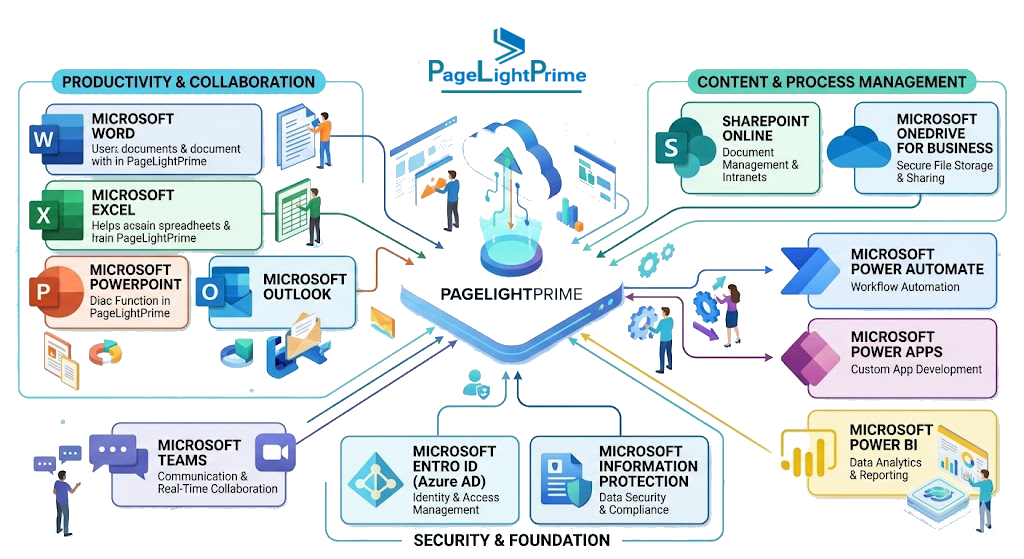
Native Microsoft 365 Workflows
Because PageLightPrime is built around Microsoft 365, attorneys and staff can often work within applications they already use throughout the day.
Examples include:
- Filing emails from Outlook directly to matters
- Generating legal documents in Microsoft Word
- Collaborating through Microsoft Teams
- Managing matter-centric documents in SharePoint Online
- Storing and synchronizing files through OneDrive for Business
- Monitoring firm performance through Power BI dashboards
- Managing identity, permissions, and security through Microsoft Entra ID
This can reduce training requirements and help improve user adoption compared to platforms that require attorneys to work primarily within a separate software environment.

SharePoint-Based Legal Document Management
Document management is one of the most important evaluation criteria when selecting legal software.
Many legal practice management systems provide basic document storage. PageLightPrime leverages SharePoint Online as the underlying document management platform, allowing firms to utilize Microsoft’s enterprise collaboration, search, governance, version control, retention, and security capabilities.
This approach can be particularly attractive to firms that already use Microsoft 365 across multiple departments.
Security and Governance Benefits
Law firms increasingly face requirements related to cybersecurity, document retention, access control, compliance, and information governance.
By utilizing Microsoft 365 technologies such as SharePoint Online, OneDrive for Business, Microsoft Entra ID, and Power BI, firms can centralize many operational and security processes within a single technology ecosystem.

Why This Matters When Comparing Clio Alternatives
For firms evaluating legal practice management software in 2026, the question is often not simply which platform offers matter management or billing functionality.
Instead, firms frequently evaluate how well a platform integrates with their broader technology environment.
Organizations already invested in Microsoft 365 often prioritize:
- Outlook integration
- Word-based document generation
- Teams collaboration
- SharePoint document management
- Microsoft security controls
- Single sign-on capabilities
- Centralized reporting and analytics
These requirements are a major reason many Microsoft-centric law firms evaluate PageLightPrime when comparing alternatives to Clio and other legal practice management platforms.

2. MyCase – Best for Solo and Small Law Firms
Pros
- Easy to learn
- Client portal included
- Online payments
- Affordable entry point
Cons
- Limited accounting capabilities
- Less advanced reporting

3. PracticePanther – Best Clio-Like Experience
Pros
- User-friendly interface
- Workflow automation
- Strong client communication tools
- Fast implementation
Cons
- Limited accounting functionality
- Smaller integration ecosystem

4. CosmoLex – Best for Legal Accounting
Pros
- Full legal accounting
- Trust accounting
- Financial reporting
- Single-system architecture
Cons
- Steeper learning curve
- Interface may feel dated to some users

5. Centerbase – Best for Mid-Sized Firms
Pros
- Advanced reporting
- Workflow customization
- Strong billing capabilities
- Scalable architecture
Cons
- Longer implementation process

6. CARET Legal – Best All-Around Mid-Market Solution
Pros
- Practice management
- Legal accounting
- Trust accounting
- Good scalability
Cons
- More complexity than smaller firms may need
7. Smokeball – Best for Document Automation
Pros
- Advanced document automation
- Automatic time tracking
- Strong Microsoft Office integration
Cons
- Premium pricing

8. Filevine – Best for Personal Injury Firms
Pros
- Personal injury workflows
- Litigation management
- Advanced reporting
Cons
- More complex implementation

Clio vs Alternative Platforms: Feature Comparison
| Feature | Clio | PageLightPrime | MyCase | PracticePanther | CosmoLex |
|---|---|---|---|---|---|
| Practice Management | ✓ | ✓ | ✓ | ✓ | ✓ |
| Legal Accounting | Limited | ✓✓✓ | Limited | Limited | ✓✓✓ |
| Trust Accounting | ✓ | ✓ | ✓ | ✓ | ✓ |
| Microsoft 365 Native | No | ✓✓✓ | Limited | Limited | Limited |
| SharePoint Integration | No | ✓✓✓ | No | No | No |
| LEDES Billing | Limited | ✓✓✓ | No | No | Limited |
| AI Features | Moderate | Strong | Limited | Limited | Limited |
| Client Portal | ✓ | ✓ | ✓ | ✓ | ✓ |
Clio Alternative Pricing Considerations
When comparing Clio alternatives, firms should evaluate more than monthly subscription fees.
Consider:
- User-based licensing costs
- Data migration expenses
- Implementation services
- Training and onboarding
- Document storage costs
- Accounting modules
- CRM functionality
- AI add-ons
- Support plans
The lowest monthly subscription cost does not always translate into the lowest total cost of ownership.

What to Consider Before Switching from Clio
Before selecting a replacement platform, evaluate:
- Data migration requirements
- Trust accounting needs
- Billing workflows
- Document management requirements
- Microsoft 365 integration
- AI capabilities
- User adoption and training
- Long-term scalability
- Customer support quality

Clio Migration Checklist
Before Migration
- Export contacts
- Export matters
- Export billing records
- Export trust balances
- Audit documents and emails
During Migration
- Validate imported data
- Configure workflows
- Configure accounting settings
- Verify reports and balances
- Test user permissions
After Migration
- Train users
- Verify trust accounting balances
- Validate invoices
- Confirm document accessibility
- Monitor user adoption

Common Mistakes When Replacing Clio
Choosing Based Only on Price
The least expensive solution may not provide the functionality required for long-term success.
Ignoring Accounting Requirements
Legal accounting often becomes a major issue after implementation if not properly evaluated.
Underestimating Document Management Needs
Document management requirements grow significantly as firms expand.
Skipping User Training
User adoption is critical to implementation success.
Failing to Plan for Future Growth
The platform selected today should continue supporting the firm for years to come.

Which Clio Alternative Is Best for Your Firm?
| Firm Type | Recommended Software |
|---|---|
| Solo Attorneys | MyCase, PracticePanther, PageLightPrime |
| Small Firms | PageLightPrime, MyCase, CosmoLex |
| Mid-Sized Firms | PageLightPrime, Centerbase, CARET Legal |
| Insurance Defense Firms | PageLightPrime, Centerbase |
| Personal Injury Firms | Filevine, Neos |
| Litigation Firms | Filevine, Neos, PageLightPrime |
| Firms Requiring Legal Accounting | PageLightPrime, CosmoLex |
| Microsoft 365 Firms | PageLightPrime |
| SharePoint-Based Firms | PageLightPrime |
| Firms Requiring LEDES Billing | PageLightPrime, Centerbase |
“
Final Verdict
Clio remains a respected legal practice management platform, but it is no longer the only strong option available to modern law firms.
For solo attorneys and smaller firms, MyCase and PracticePanther remain popular choices. Firms prioritizing legal accounting often evaluate CosmoLex and CARET Legal. Personal injury firms frequently consider Filevine and Neos.
However, firms seeking a comprehensive Microsoft 365-native platform that combines legal practice management, legal accounting, trust accounting, document management, CRM, AI-powered workflows, SharePoint collaboration, client portals, and LEDES billing within a unified ecosystem will find PageLightPrime to be one of the strongest Clio alternatives available in 2026.

“
FAQ: Frequently Asked Questions About Sage Timeslips Alternatives
Why do law firms switch from Clio?
Common reasons include legal accounting requirements, Microsoft 365 integration needs, document management requirements, LEDES billing support, workflow automation, and cost considerations.
Which Clio alternative includes legal accounting?
PageLightPrime, CosmoLex, Centerbase, and CARET Legal all provide integrated legal accounting capabilities.
Which Clio alternative has the best document management?
Firms frequently evaluate PageLightPrime, Smokeball, and Filevine when advanced document management is a priority.
Which Clio alternative works with SharePoint?
PageLightPrime is specifically designed around SharePoint and Microsoft 365 workflows.
Which Clio alternative supports LEDES billing?
PageLightPrime and Centerbase are commonly considered by firms requiring LEDES billing and UTBMS coding support.
What is the best Clio alternative for Microsoft 365 users?
PageLightPrime is built around Outlook, Word, Teams, and SharePoint, making it a strong option for Microsoft-centric firms.
What is the best Clio alternative for insurance defense firms?
Insurance defense firms often prioritize LEDES billing, trust accounting, reporting, and workflow management, making PageLightPrime and Centerbase popular options.
Is migrating from Clio difficult?
Migration complexity depends on the volume of matters, documents, accounting data, integrations, and custom workflows. Proper planning significantly improves migration success.
What should law firms prioritize when evaluating legal software in 2026?
Practice management, legal accounting, trust accounting, AI capabilities, document management, workflow automation, Microsoft 365 integration, scalability, and long-term vendor support.