
Legal Software Canada (2026): The Complete Microsoft 365 Platform for Canadian Law Firms
Legal software for Canadian law firms has evolved from basic practice management tools into complete operating platforms. Today, modern legal operations require an environment that supports every single aspect of a firm: matter management, legal accounting , trust accounting, law firm document management , billing, CRM, workflow automation, reporting, and client collaboration.
Canadian law firms face increasing pressure to improve productivity, strengthen cybersecurity, maintain strict provincial trust accounting compliance, manage growing volumes of digital documents, and meet demanding client expectations. Yet, many firms continue to operate with a fragmented stack—combining general accounting applications, shared network drives, scattered email folders, spreadsheets, and disconnected legacy systems. These siloed environments create duplicate work, reduce financial visibility, increase compliance risks, and make it difficult for firms to scale.
Written by Knowledge Team, posted on July 01, 2026

Modern legal technology is moving toward unified platforms that securely connect legal work, financial operations, documents, communications, and collaboration in a single environment.
A growing number of firms are evaluating legal practice management software Canada 2026 solutions that align with the technology platforms they already use. Microsoft 365 has become the foundational productivity platform for professional services, making Microsoft 365 law firm software increasingly attractive for firms seeking secure, scalable, and integrated legal technology.
What is PageLightPrime Legal Practice Management Software
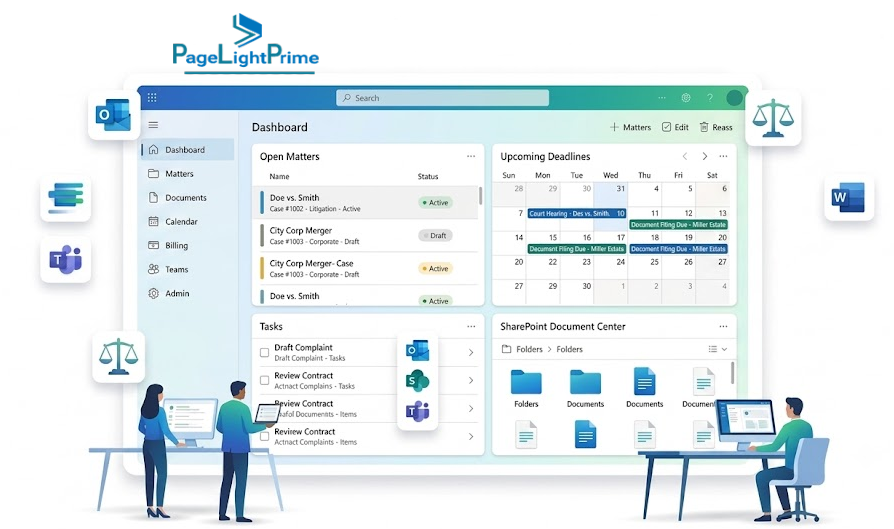
PageLightPrime is a Microsoft 365-native legal practice management platform built directly on Microsoft Outlook, Microsoft Word, Microsoft Teams, SharePoint Online, OneDrive for Business, Power BI, and the broader Microsoft ecosystem. Unlike traditional legacy platforms that store your firm’s sensitive data and documents inside proprietary, vendor-controlled databases, PageLightPrime enables Canadian law firms to manage matters, documents, accounting, billing, and client relationships completely within their own secure Microsoft 365 environment.
PageLightPrime is purpose-built for:
- Solo practitioners and boutique law firms
- High-volume litigation practices and insurance defense firms
- Real estate, family law, and corporate legal departments
- Mid-sized Canadian law firms looking to scale safely
This comprehensive guide explains what Canadian law firms must evaluate when selecting modern legal software and why Microsoft 365-native architecture has become the gold standard across Canada.
What Is Legal Software for Canadian Law Firms
Legal practice accounting software for Canadian law firm is specialized technology designed to help law firms centralize and manage operations, client matters, accounting, documents, billing, workflows, and communications from a single secure platform.
Modern legal software typically includes:
- Matter management and real-time conflict checking
- Comprehensive legal accounting and trust accounting
- Mobile-friendly time tracking and legal billing
- Document management and native email management
- Integrated legal CRM Canada capabilities for client intake
- Advanced workflow automation and Power BI reporting
- Secure client portals for seamless collaboration

For Canadian law firms, legal software cannot simply be generic. It must actively support strict regulatory obligations, provincial trust accounting requirements, tax reporting mandates (GST/HST/PST), regional privacy laws, and robust data security expectations.
Modern platforms are heavily evaluated based on whether they provide:

Why Canadian Law Firms Are Replacing Fragmented Systems
Operating with disconnected, standalone applications creates a massive drag on firm profitability and security. A typical fragmented firm splits its daily operations across isolated tools:
- Microsoft Outlook for isolated email communication
- Microsoft Word for localized document drafting
- Shared Network Drives for unorganized document storage
- Excel Spreadsheets for manual matter and pipeline tracking
- Generic Accounting Software unaligned with legal regulations
- Standalone Billing & CRM Tools that don’t talk to each other
While these tools individually perform their core functions, using them in silos creates severe structural challenges.

Key Problems with Fragmented Systems
- Duplicate Data Entry: Information must be manually keyed multiple times across different systems, skyrocketing administrative overhead and data entry errors.
- Poor Document Visibility: Lawyers and staff struggle to locate the latest version of documents, losing track of critical matter files scattered across local folders and email attachments.
- Compliance Risks: Disconnected systems make it incredibly difficult to maintain consistent access controls, reliable audit trails, retention policies, and compliant financial records.
- Limited Reporting: Data locked inside isolated software prevents partners from obtaining a complete operational view of matter performance, billing trends, real-time productivity, and financial health.
- Higher Software Costs: Paying for multiple software licenses, complex integrations, varied staff training, and ongoing IT overhead heavily drains firm resources.
- Fragmented Workflows: Legal professionals waste billable hours moving information between windows rather than completing actual client work.

Why Law Firms Are Modernizing Legal Technology
Legal technology adoption is accelerating rapidly across Canada as firms demand greater efficiency, stronger data protection, and absolute operational visibility. Modern firms recognize that legal software is no longer a luxury; it is the central operating platform connecting:
Industry analysis shows a significant surge in firm investments toward cloud-based practice management, legal workflow automation, and artificial intelligence readiness.
Importantly, forward-thinking Canadian law firms are evaluating whether their technology investments align with broader enterprise standards. Because Microsoft 365 is already the most widely adopted platform among professional organizations, Microsoft-native legal software allows firms to maximize their existing IT investments rather than introducing another risky, disconnected third-party database.

Technologies Used by Modern Canadian Law Firms
Modern Canadian law firms operate within a unified digital ecosystem powered natively by Microsoft technologies:
- Microsoft 365 & Outlook: The core engine for daily communication, secure calendars, and matter-centric email archiving.
- SharePoint Online & OneDrive: The foundation for secure, structured document storage, enterprise content management, and deep version control.
- Microsoft Teams: Real-time collaboration, internal firm strategy, and secure client meetings.
- Power BI: High-level operational intelligence that transforms law firm data into actionable visual dashboards.
- Microsoft Entra ID & Copilot: Enterprise identity management (MFA, Conditional Access) and a secure launching pad for native, in-tenant Artificial Intelligence.

Microsoft 365 as the Core Legal Operating System
For most Canadian firms, Microsoft 365 is already open on every laptop and desktop all day. A Microsoft 365-native legal platform extends these tools into a comprehensive legal operating system.
Instead of forcing lawyers out of their natural environment, it brings matter tracking, time entries, and trust ledgers directly into Outlook, Word, and Teams. This reduces friction, accelerates staff adoption, and keeps all communications securely linked to the correct client file.
Key Requirements for Canadian Law Firms
Selecting legal software requires looking far beyond a surface-level feature list. Canadian firms have rigid operational guardrails that their platform must natively support.
1. Trust Accounting Compliance
Trust accounting is a strict regulatory requirement. Law firms handle client retainers and settlement funds that represent liabilities, not firm revenue. Legal software supporting Canadian firms must provide:
- Matter-level trust ledgers and real-time balance tracking
- Compliant client fund management and automated transaction history
- Audit-ready reporting and structured 3-way reconciliation workflows
- Rigorous financial controls to prevent accidental comingling of funds

2. GST / HST / PST Management
Canadian law firms require robust financial systems that natively calculate and track Canadian taxation variations. The platform must effortlessly manage multi-provincial tax rules (like Ontario’s HST or British Columbia’s GST + PST splits) on fees and disbursements, ensuring absolute invoice accuracy and flawless financial reporting without manual spreadsheets.
3. Data Security & Governance
Law firms are prime targets for cyber threats because they manage highly sensitive, privileged information. Modern legal platforms must provide enterprise-grade encryption (at rest and in transit), role-based access controls, complete audit logs, and secure cloud infrastructure. Security is no longer an IT afterthought—it is a core pillar of professional compliance.
4. Records Retention & Document Lifecycles
Firms require a structured, automated approach to managing files from intake to final archive. This includes automated version control, customizable metadata tagging, matter-based organization, and defensible retention policies that align with law society guidelines.
Legal Software Compliance Requirements in Canada
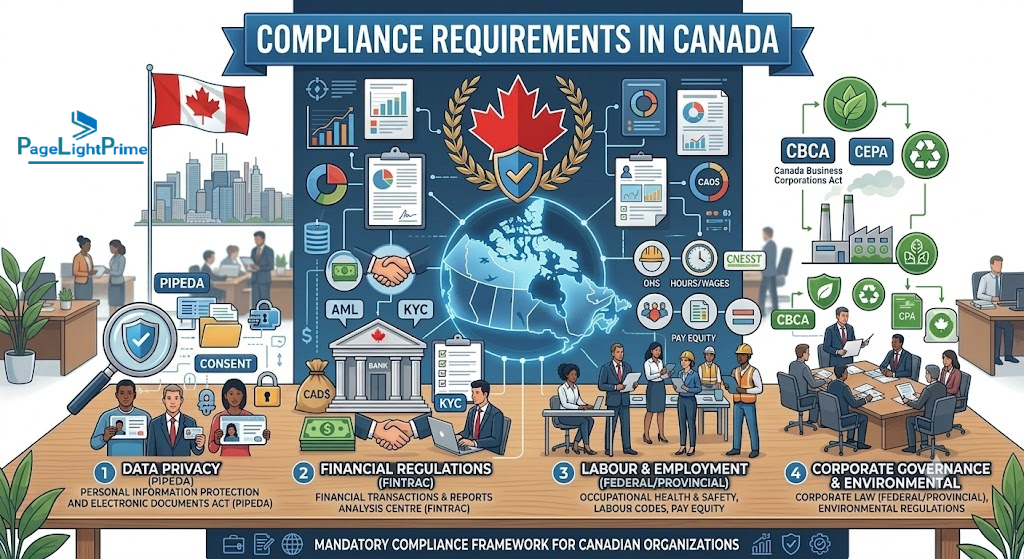
Canadian law firms evaluate technology through the lens of strict regulatory, privacy, and financial frameworks.
Provincial Law Society Rules
Every province has explicit rules regarding how trust accounts are handled, records are maintained, and monthly reconciliations are generated.
- Law Society of Ontario (LSO): Demands flawless trust reconciliations and strict compliance protocols. Under new LSO guidelines, firms must maintain pristine transparency to meet audit readiness.
- Law Society of British Columbia (LSBC): Mandates rigid financial recordkeeping and absolute precision in client ledger balances.

Privacy & Data Residency Regulations
Under Canadian privacy legislation (including PIPEDA and provincial equivalents), law firms must ensure stringent controls over confidential client data. For many firms, cloud legal applications must satisfy clear Canadian Data Residency requirements—ensuring data, documents, backups, and logs are physically stored within Canadian borders.
Cybersecurity Frameworks
Firms increasingly align their technology selections with established industry standards:
- Canadian Centre for Cyber Security (CCCS) Guidelines: Focusing on identity protection, multi-factor authentication (MFA), and secure remote access.
- ISO 27001 & SOC 2 Type II Standards: Ensuring cloud providers maintain strict security governance, operational availability, and data confidentiality controls.

PageLightPrime Architecture & Security Foundation
PageLightPrime is built as a true Microsoft 365-native legal practice management platform. Rather than relying on an isolated proprietary technology stack hosted on an unknown third-party server, PageLightPrime extends the Microsoft environment already owned and controlled by your firm.
1. Runs Within the Customer-Owned Tenant
PageLightPrime operates directly inside your firm’s Microsoft 365 tenant. This means your firm retains 100% data ownership and governance control. Your data never leaves your environment to sit in a vendor’s silo, significantly reducing third-party data supply chain risks.
2. Uses SharePoint Online as the Document Repository
All files, contracts, and legal briefs are stored directly in your firm’s secure SharePoint Online document management infrastructure. This leverages enterprise-grade document libraries, absolute version control, rich metadata search, and Microsoft-backed compliance lifecycles automatically.

3. Leverages Microsoft Entra ID
Authentication and access are fully governed by Microsoft Entra ID. This means your existing IT security rules—such as Multi-Factor Authentication (MFA), Conditional Access policies, and single sign-on (SSO)—apply to PageLightPrime out of the box.
4. Direct Support for Canadian Data Residency
By deploying on Microsoft Azure’s Canadian data center regions, PageLightPrime ensures all firm and client data remains strictly within Canada, satisfying provincial regulatory expectations and institutional client requirements.

Why Microsoft 365 Law Firms Choose PageLightPrime
Traditional legal software forces you to extract files from Microsoft and re-upload them into a vendor’s proprietary cloud database, fragmenting your workflows. PageLightPrime does the exact opposite: it embeds robust legal practice workflows into the Microsoft apps your team uses every single day.
Key Benefits of PageLightPrime
- Full Document Ownership: You maintain total control over your intellectual property. If you ever leave a traditional cloud vendor, pulling your files out of their database can be a nightmare. With PageLightPrime, your files always remain securely in your own SharePoint.
- Zero-Silo AI Architecture: Unlike standalone legal AI tools (such as Harvey or Legora) that require you to upload confidential client data into external, third-party AI silos, PageLightPrime keeps your data in your tenant. This ensures your firm is instantly primed for secure enterprise AI tools like Microsoft Copilot without risking data exposure.
- Unified Financials: Connects matter tracking directly to legal billing, trust ledgers, and expense tracking, cutting down manual bookkeeping time significantly.

PageLightPrime vs. Leading Legal Software
When evaluating practice management software, it is vital to look at architectural integration. Standard practice systems lack native Microsoft 365 depth, while specialized AI tools completely lack accounting and billing workflows.
| Feature / Capability | PageLightPrime | Clio / CosmoLex | Harvey / Legora |
|---|---|---|---|
| Microsoft 365 Native | Yes | No | No (API Integrations Only) |
| SharePoint Document Control | Yes | No | No |
| Outlook Native Workflows | Yes | Limited Add-on | Limited Add-on |
| Legal Accounting & Trust Ledgers | Yes | Add-on / Partial | No (Strictly AI/Drafting) |
| Bilingual Invoice Support (CRA) | Yes | Limited | No |
| Zero-Silo AI Architecture | Yes (Via Copilot) | No | No (Proprietary Silos) |
| Automated Workflows | Yes | Limited | Limited |
Legal Software by Practice Area
Different practice areas require distinct, specialized operational workflows. PageLightPrime scales across your practice groups by layering legal automation over your Microsoft environment.
Insurance Defense & Litigation Firms
- Structured case tracking and litigation timeline mapping
- Seamless document-heavy organization inside SharePoint Online
- Compliance with UTBMS and LEDES billing workflows required by insurance carriers
- Comprehensive activity auditing and advanced deadline management
Real Estate Law Firms
Real estate practices rely on extreme financial accuracy, fast document turnarounds, and rapid client communications. Key capabilities include:
- Automated conveyancing workflows and disbursement tracking
- Flawless matter-level trust ledger updates for closing funds
- One-click document automation for transaction paperwork
- Direct transaction history logging to ensure audit readiness
Family & Corporate Law
Managing highly sensitive, private timelines and extensive contract lifecycles demands absolute privacy governance. PageLightPrime provides:
- Secure internal collaboration via private Microsoft Teams channels
- Centralized contract lifecycle management and document versioning
- Controlled client portal access to share sensitive documents safely
- Strict role-based permissions ensuring confidential data is viewable only by assigned team members

How Canadian Law Firms Choose Legal Software
Selecting your firm’s core software is a long-term strategic decision. Canadian firms can use this structured five-part framework to evaluate potential platforms:
1. Accounting & Tax Capability
Does the platform support automated 3-way reconciliations? Is it designed to natively handle Canadian tax variations (GST/HST/PST) across different provinces? Is it fully audit-ready for a Law Society review?
2. Integration Depth
Is the software merely connected to Microsoft via a basic, brittle third-party API plugin, or is it fundamentally built on Microsoft? True efficiency requires working natively within Outlook, Word, and Teams without constant jumping between applications.

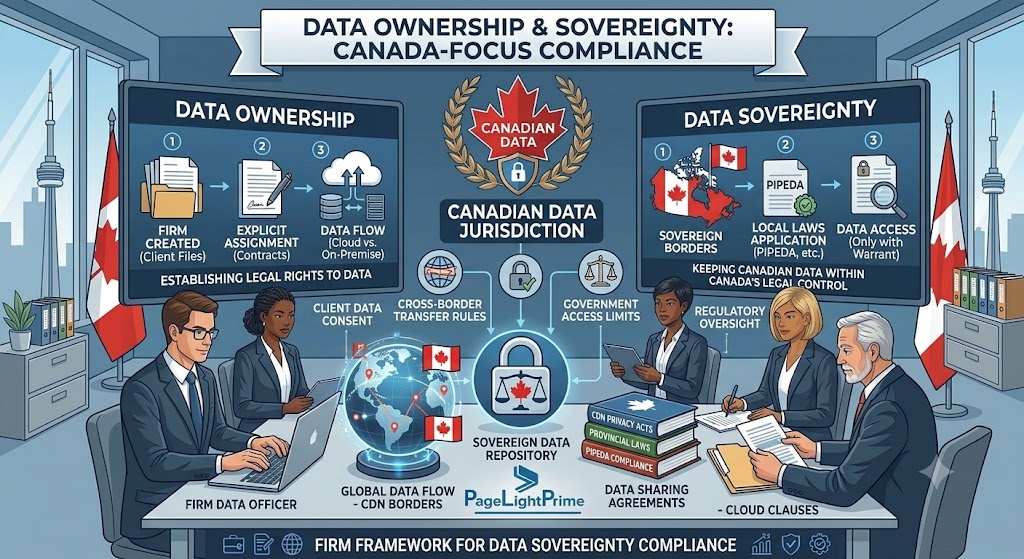
3. Data Ownership & Sovereignty
Where is your data physically stored? Do your legal files reside in a third-party proprietary database, or do you maintain complete data residency and governance within your own company-controlled tenant?
4. Security & Compliance Controls
Does the platform match enterprise cybersecurity expectations? Look for solutions that leverage your existing security infrastructure, providing MFA, robust encryption, and granular access logging automatically.
5. Future Scalability & AI Readiness
Will the software scale as your matter volumes and team expand? More importantly, does its data structure allow you to adopt modern AI tools securely, or does it lock your firm’s data away in an isolated silo?
“
Conclusion
The future of legal technology for Canadian law firms belongs to highly secure, integrated platforms that eliminate operational fragmentation. Modern practices require an environment that unifies legal practice management, strict trust accounting compliance, localized billing workflows, and advanced document governance into a single cohesive stack.
PageLightPrime provides a powerful, Microsoft 365-native practice management platform designed exactly for the compliance, security, and operational expectations of modern Canadian law firms.
By building directly on top of your firm’s existing Microsoft 365 security ecosystem, SharePoint Online document repositories, and Entra ID identity management, PageLightPrime gives your firm absolute data ownership and unparalleled workflow efficiency. It allows your lawyers to stop fighting disconnected software and focus entirely on what matters most: delivering exceptional legal results for your clients.

“
FAQ: Frequently Asked Questions About Sage Timeslips Alternatives
Does PageLightPrime support Law Society trust accounting rules in Canada?
Yes. PageLightPrime features built-in trust accounting workflows meticulously designed to keep Canadian law firms fully compliant with provincial law society requirements, including handling matter-level ledgers and 3-way financial reconciliations.
How does PageLightPrime handle Canadian taxes like GST, HST, and PST?
The platform has a robust, localized legal billing engine that automatically handles provincial tax variations across Canada on both legal fees and client disbursements, ensuring absolute invoice accuracy.
Can we keep all our data stored within Canada?
Yes. Because PageLightPrime runs within your own Microsoft 365 tenant, your data residency is completely determined by your Microsoft cloud setup. By using Microsoft’s Canadian Azure data centers, all documents, client files, and financial logs remain strictly within Canada.
How does PageLightPrime compare to standalone legal AI tools like Harvey or Legora?
Harvey and Legora are specialized AI drafting and research tools that require you to upload files into external, proprietary databases, creating potential data silos. PageLightPrime is a complete practice management and financial accounting platform. It keeps all data inside your secure Microsoft tenant, making your files safely accessible to native AI engines like Microsoft Copilot without data security leaks.
Is SharePoint genuinely suitable for legal document management?
Absolutely. When configured correctly through a legal platform like PageLightPrime, SharePoint Online acts as an enterprise-grade document management system, providing robust version control, customizable metadata tagging, firm-wide search, and ironclad document permissions.